Sheep and cattle require a range of essential trace minerals to support metabolic functions needed for optimal health, fertility and performance.
One of the most important of these is selenium, which has a role in preventing cellular oxidation, disease resistance, muscle function and fertility.1
Elanco senior brand manager for cattle, Kim Krilich, says selenium deficiency can occur in all classes of sheep and cattle.
“Deficiencies can occur if livestock don’t consume enough selenium from pasture or rations, or if it is not available in a form that the animal can absorb and metabolise,” she says.
“Many soil types found throughout Australia, such as sandy coastal, acidic or granite soils, are deficient in selenium.”2
“It is particularly prevalent in high rainfall areas (>450 mm rain per year), where improved, irrigated or fertilised pastures can grow rapidly, such as a spring flush.”
Symptoms of clinical deficiency in young livestock include scouring; stiff gait, arched back or lameness; reduced growth rates; increased susceptibility to parasites and disease; and sudden death resulting from heart failure.3
In adult sheep and cattle, symptoms include ill-thrift; reduced fertility; stillbirths and weak lambing/calving; retained foetal membranes; mastitis; and reduced wool and milk production.3
“These symptoms are the tip of the iceberg.”
“We see a loss in productivity and performance in livestock occurring well before these symptoms are present, which can often go unnoticed.”
Kim says it’s important to consult a veterinarian or animal health advisor to determine the selenium status of your livestock before commencing a supplementation program.
“Selenium status is best determined using blood or liver samples and taken from livestock that have not had access to any supplementary sources of selenium,” she says.
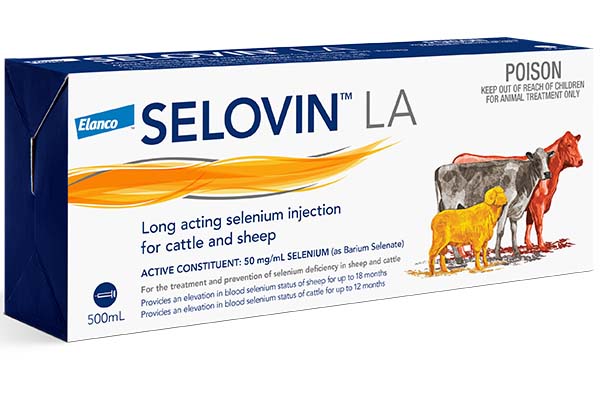
Sheep and cattle with low levels of selenium or at risk of clinical deficiency should be treated with a suitable long-acting therapy, such as Selovin™ LA from Elanco.
A convenient, single treatment will elevate blood selenium levels for up to 18 months in sheep and up to 12 months in cattle.
Its sustained activity provides a steady supply of selenium over the payout period and minimises the risk of selenium toxicity.
Selovin LA is administered as a subcutaneous injection using Elanco’s 7 mL or 15 mL injector fitted with an 18-gauge needle (sheep) or a 16-gauge needle (cattle) that is less than 15 mm in length.
The dose rate is 0.5 mL per head in lambs, 1 mL per head in sheep and 1 mL per 50 kg body weight in cattle.
“Care should be taken to avoid overdosing, particularly during early pregnancy,” Kim says.
“Always weigh your livestock and determine the correct dose rate on the label based on the heaviest animal in the mob.”
Kim stresses the importance of correct administration technique and maintaining good hygiene throughout the administration process.
“The injection site is high on the neck behind the ear, which minimises the risk of any carcase damage.”
“Raise the skin into a ‘tent’ and insert the needle parallel to the body to release the dose under the skin, taking care to avoid self-injection.”
“Make sure the needles are clean and sharp, and replace them as necessary.”
“Maintain cleanliness and avoid administration during wet or dusty conditions.”
Sheep and cattle can also be exposed to sub-clinical mineral deficiencies if they cannot meet their nutritional requirements from consumed feed during critical stages of the production cycle, such as before joining, lambing, calving or weaning.
In this situation, livestock may benefit from treatment with a short-acting selenium supplement, such as Cobalife™ VB12 Plus Selenium or MultiBoost™ with B12 for cattle.
Always read and follow the label directions. Results may vary based on current mineral status and additional sources of trace minerals.
Cobalife, Selovin, Elanco and the diagonal bar logo are trademarks of Elanco or its affiliates. MultiBoost is a trademark of Biocell Corporation. ©2026 Elanco or its affiliates. EAH26219. PM-AU-26-0501.
References: 1. National Research Council (2000). Nutrient Requirements of Beef Cattle: 7th Revised Edition. Washington DC. The National Academies Press.
2. Judson, G.J. & Reuter, D.J. (1999) Selenium. In Soil Analysis: An Interpretation Manual, pp. 325-329. [Peverill, K.I. et. al. editors]. Melbourne, CSIRO Publishing.
3. Puls, R. (1994). Mineral levels in animal nutrition - Diagnostic Data. 2nd edition. Sherpa International, Canada.
This article was written by Kim Krilich – Elanco Senior Brand Manager, for Seasons.
Disclaimer - important, please read:
Elders provides recommendations to the best of its knowledge and based on assumptions and information which it understands to be up to date, complete and accurate. If you are aware of any error or inaccuracy with the information on which this recommendation is based, you must immediately bring this to Elders’ attention. This recommendation is provided for your use only, and not that of any other third party. In some circumstances, the information Elders provided may be in summary form or derived from information sourced from third parties, however, Elders has not independently verified the information and cannot guarantee its accuracy.
You should always carefully evaluate all available information and consult Elders or another advisor further before you commit to any course of action or rely on any recommendation. Additionally, Elders expects that you will use your knowledge, experience and best judgement in relying on any recommendation and determining whether the recommendation is, and continues to be, appropriate. Elders do not accept liability or responsibility for any indirect, consequential or economic loss or damage of any kind arising from your acceptance or reliance on this recommendation. To the fullest extent permitted by law, all guarantees, warranties or implied terms and conditions are expressly excluded and Elders’ liability with respect to any services provided is limited to re-supply of the services, or the cost of having the services re-supplied. Elders may from time to time recommend products or services for which it may receive a financial incentive (rebate, commission, benefit, etc) from a supplier/manufacturer directly related to your purchase or use of that product or service.