
Through a new Elders-led monitoring pilot, Goulburn Valley apple and pear growers are getting a clearer picture of pest activity in their orchards. The pilot is designed to support more timely and informed crop protection decisions.
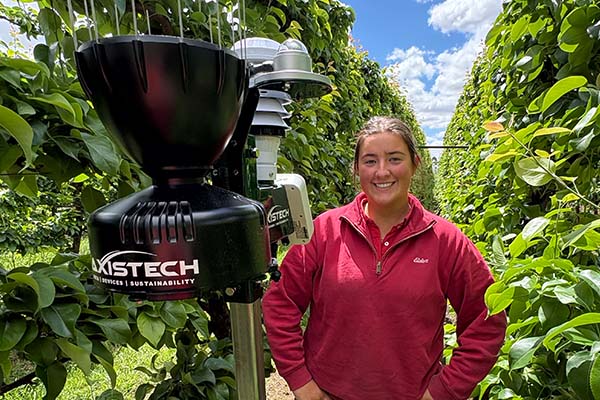 Graduate Agronomist Emily Schrader from Elders Shepparton alongside one of the weather stations used in the pilot program.
Supported by AgNova and Agrion, the two-year Goulburn Valley Trap Program is responding to a practical challenge for local growers: having accurate, timely information on pest and disease pressure to help determine when to act and how best to protect their crop.
Since going on-farm in September, Elders has established around 30 automated CropVue insect traps across five local growers, initially targeting Codling Moth in apples. The program was also recently provided a six-month progress report to 11 growers at an Elders-hosted event in Shepparton.
The traps capture daily images and pest activity, which can be considered alongside weather data and pest and disease modelling.
Elders agronomists use this information together with what they are seeing in the orchard to help growers make more targeted decisions throughout the season.
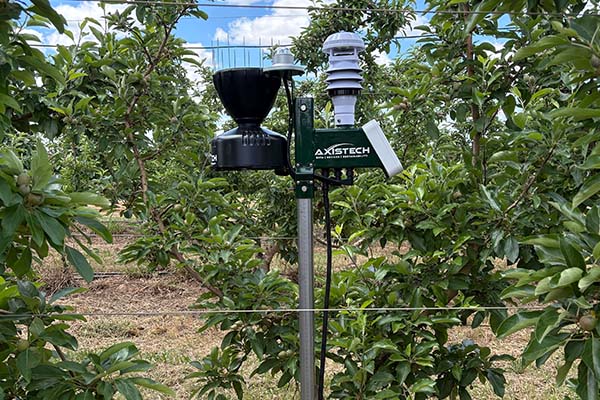 A weather station set up in an orchard as part of the Goulburn Valley Trap Program.
Elders Shepparton graduate agronomist Emily Schrader said that access to better field data was an important part of supporting growers with their agronomy programs.
“Field data is a really important part of developing an agronomy program for our growers,”
“Investing in technology like weather stations, automated insect traps and pest and disease modelling gives us more accurate, timely information that we can use to improve application timing and make better decisions on-farm.”
Leading the Goulburn Valley Trap Program, Elders Technical Services Manager Michelle Towers said timely data was particularly valuable because many crop protection decisions need to be made before pest or disease damage becomes apparent.
“A lot of the decisions we make in the field as agronomists are based on the pest and disease levels we see, but much of the chemistry we use, particularly for disease, is preventative,” Michelle said.
“Having this information means we can be much more targeted with our programs and use the right chemistry, in the right place, for the right reasons.”
That precision is particularly important when managing Codling Moth. Once pest flights are detected, temperature and degree-day data can help agronomists track stages of the pest lifecycle and identify when an application is likely to have the greatest impact.
“We need to be very strategic about when we apply our chemistry, not only to get the best result from each application, but to put it in the best place within the overall program,” Michelle said.
“As agronomists, we have that dual responsibility. We want to make sure the grower gets good control, but we also need to look after those important chemistry groups and help manage the risk of resistance, so they remain effective into the future.”
Participating growers also have access to their own data in real time, allowing them to follow pest activity and trends throughout the season while working with their Elders agronomist to understand what the information means for their orchard.
While initially focused on Codling Moth in apples and pears, the two-year pilot will allow Elders and participating growers to build their understanding of the technology and explore its potential to support the monitoring of other pests and horticultural crops.
For Goulburn Valley horticulture growers interested in putting better pest data behind their crop protection decisions, contact the Elders Shepparton team to learn more about the program and opportunities to participate.