Elders Senior Livestock Production Manager Rob Inglis shares his tips on preparing stock in the potential event of an El Nino season.
There is an aphorism with which every livestock producer will be familiar. Reproductive rate (fertility) is the key profit driver. There has never been a better time than now to have fertile breeding stock. Ensuring said breeding stock are fit for purpose has seldom been more central to long term profitability.
The ewes and cows which wean the heaviest lambs and calves, are the most profitable. They will also lose the most condition during lactation.
For every action, there is an equal and opposite reaction. Therefore, every increment of weight or condition taken off fertile females this year, will potentially affect reproductive performance next year. There is no doubt that the condition score of the dam at joining has a profound effect on both conception rates and more importantly, progeny survival in subsequent years. This was discussed in the Livestock Now article Managing the nutrition of your weaners, including the importance of cow and ewe condition on colostrum production, brown fat deposition and lactation, thus survival.
With all that in mind, it is worth considering the implications of the forecast dry spring. Every kilo of pasture should be cherished. As the graphs below show, pasture growth projections for the next three months aren’t looking too bright. These graphs are the product of data and modelling by the NSW Local Land Services and CSIRO Farming Forecaster. The projections are based on 30 years of accumulated data and model pasture growth for the best (green), average (yellow) and worst (red) case scenarios. The black line, which represents current conditions is updated every seven days.
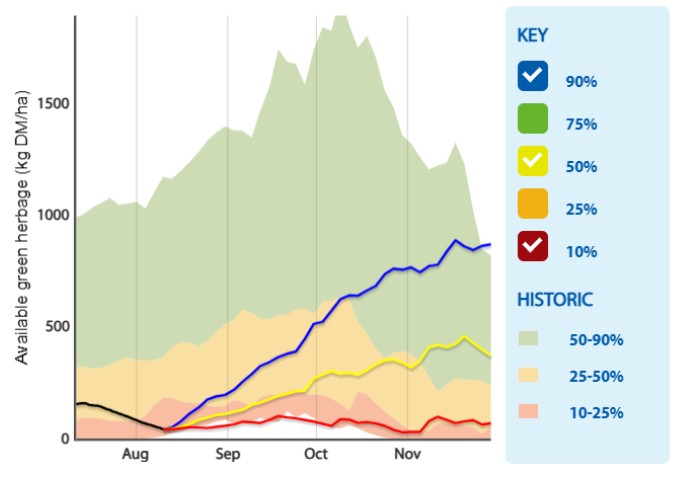 Coloured graph showing projected green herbage available, relative to historic variation in Carrathool, New South Wales. Used with permission: NSW Local Land Services and CSIRO Farming Forecaster.
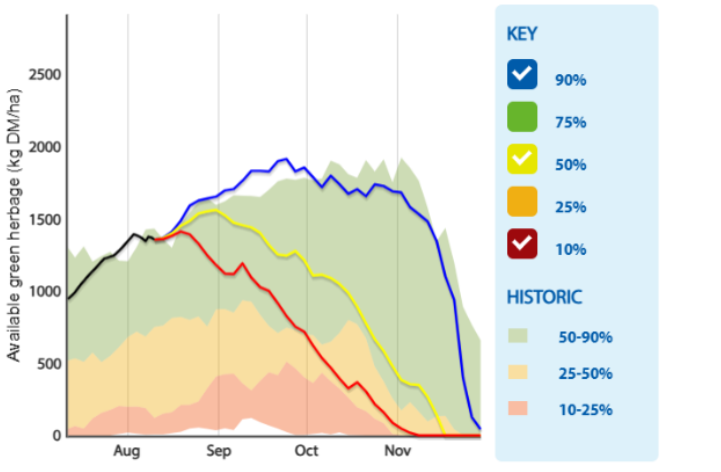 Coloured graph showing projected green herbage available, relative to historic variation in Tocumwal, New South Wales. Used with permission: NSW Local Land Services and CSIRO Farming Forecaster.
There are a number of strategies which can be deployed to mitigate the obvious consequences of a bob-tail spring. Early weaning is a very good starting point. A rough rule of thumb is that one dry sheep equivalent (DSE) will consume one kilogram of dry matter per day. If the forecast El Nino arrives, producers would be well advised to consult with an Elders Livestock Production Specialist for localised advice. They can help with tactics to preserve feed and maintain condition on females.
Sustaining ruminating calves or lambs on a milk-supplemented diet is inefficient and expensive. In cattle, by the time the calf is a functioning ruminant (at around 30 per cent of adult standard reference weight), only about 38 per cent of the metabolisable energy (ME) the cow consumes is passed on to the calf. This means the 63 per cent or thereabouts, of the ME the cow ingests is lost. To put this in elementary terms:
By extension, one could run an additional livestock unit (7DSE) for every day post weaning. In other words, 100 calves or 700 lambs weaned one month earlier liberates around 21,000 DSE days which will support an additional 6 cows or 36 ewes per year, on the same feed base.
As always, contact your local Elders livestock production specialist for tailored advice.
Disclaimer - important, please read:
Elders provides recommendations to the best of its knowledge and based on assumptions and information which it understands to be up to date, complete and accurate. If you are aware of any error or inaccuracy with the information on which this recommendation is based, you must immediately bring this to Elders’ attention. This recommendation is provided for your use only, and not that of any other third party. In some circumstances, the information Elders provided may be in summary form or derived from information sourced from third parties, however, Elders has not independently verified the information and cannot guarantee its accuracy.
You should always carefully evaluate all available information and consult Elders or another advisor further before you commit to any course of action or rely on any recommendation. Additionally, Elders expects that you will use your knowledge, experience and best judgement in relying on any recommendation and determining whether the recommendation is, and continues to be, appropriate. Elders do not accept liability or responsibility for any indirect, consequential or economic loss or damage of any kind arising from your acceptance or reliance on this recommendation. To the fullest extent permitted by law, all guarantees, warranties or implied terms and conditions are expressly excluded and Elders’ liability with respect to any services provided is limited to re-supply of the services, or the cost of having the services re-supplied. Elders may from time to time recommend products or services for which it may receive a financial incentive (rebate, commission, benefit, etc) from a supplier/manufacturer directly related to your purchase or use of that product or service.