A popular view says lower global cattle numbers will keep pushing Australian cattle prices higher. It is an argument worth taking seriously, especially with the US herd at historically low levels. But after many years watching these markets, Elders analyst Richard Koch feels there is another view farmers should hear.
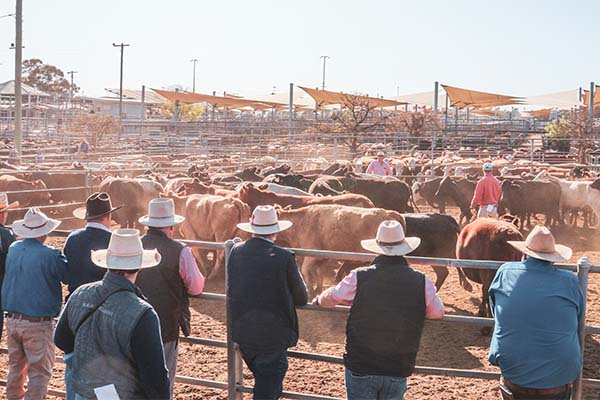
Herd numbers matter, but they are only part of the picture. Trade access, export competition, processor margins, exchange rates, consumer demand and the price of beef against chicken and pork all influence cattle demand and the prices the market can sustain.
The recent price rise is a good example. Widespread rain since late September has delivered the best broad seasonal conditions since 2022. With feed improving, many producers are holding cattle and adding weight rather than selling, tightening saleyard supply. That supports prices now, but it does not mean the world is short of beef.
Southern seasonal conditions are generally the best since 2022, reflected in strong cool-season rainfall deciles and abundant rainfall since the start of October, particularly across areas that needed it most.
The bigger question is whether beef demand and export returns can support current prices through the supply chain. In 2026, local cattle supply tightened and prices rose, but downstream beef signals were less convincing.
The US has lifted beef imports as its herd shrinks. USDA data shows the US has imported 857,400 tonnes of beef since the start of 2026 to 7 November, 22.4 per cent (pc) more than last year and 38 pc above 2024. Yet plentiful imports and seasonally softer demand have held back US prices. Australia supplied 30.6 pc of the total, Brazil 23.1pc and New Zealand 17.4pc. A smaller US herd creates import demand, but it also attracts competing exporters.
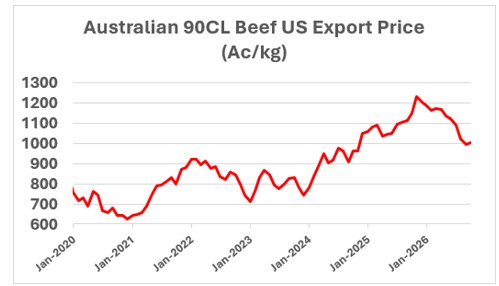 Australian 90CL beef export prices to the US, December 2025 to October 2026. Source: MLA.
Despite that demand, Australian beef export prices to the US are down 10.5 pc in $US terms, reflecting more competition and weaker food-service demand. Safeguard restrictions and high above-quota tariffs in China and Korea have also limited access for Australian beef in two key north Asian markets. The US took 43 pc of Australian beef exports last month, leaving Australia more exposed to US demand, freight, currency and competitor pricing.
The gap between cattle prices and beef returns is worth watching.
If tight beef supply were the dominant market influence, stronger export prices might be expected to provide greater support for higher cattle costs. Instead, cattle prices rose while export returns weakened, narrowing the indicative spread between cattle prices and beef export returns. That does not mean cattle prices must fall, but continued increases may be harder to sustain if beef returns do not also strengthen.
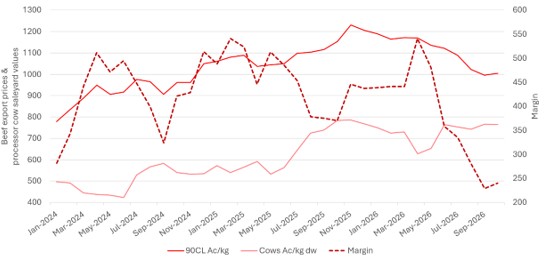 Australian beef export returns compared with the national saleyard cattle average; the gap is an indicative proxy for processing margins. Source: USDA and MLA.
The world can produce more beef without more cattle, through better genetics, higher calving rates, better pasture management, feedlot finishing. Lower US production gives Australia an opening, but it also gives competitors across south America a strong reason to invest. The key measure is kilograms of beef reaching the market, not just cattle numbers.
Brazil is the competitor I would watch most closely. Better genetics, pasture improvement, younger turn-off and increasingly grain-based finishing are allowing cattle to reach heavier weights faster. Average Brazilian carcase weights have risen from around 240 kg to around 260 kg per head over the past decade, an underlying improvement of roughly 2-3 kg per head a year. The rate of increase will lift as feedlots expand, feeding intensity rises and Brazil gains greater access to relatively low-cost corn-ethanol feed co-products.
Brazilian carcase weights eased between 2022 and 2024, but this does not necessarily represent a reversal of the longer-term productivity trend. Brazil entered the liquidation phase of its cattle cycle, sharply increasing the proportion of lighter cows and heifers in the slaughter mix. The country also remains predominantly grassfed, with only about one-fifth of slaughter coming from feedlots, so drought and variable seasonal conditions can affect pasture growth, finishing rates and sale weights.
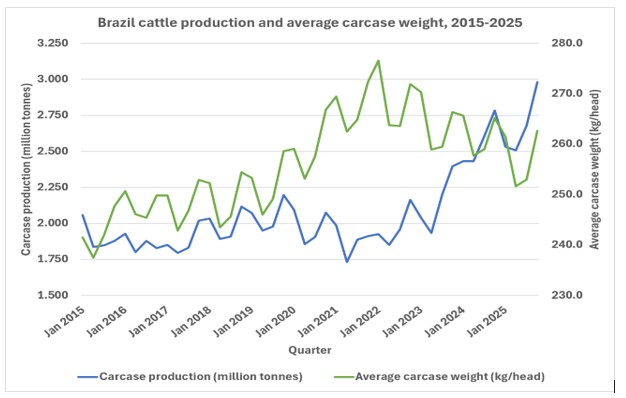 Quarterly inspected cattle production and calculated average carcase weight, 2015-2025. Source: IBGE SIDRA Table 1092, calculations from Brazilian data.xlsx.
As feedlot capacity expands, a larger proportion of cattle will become less exposed to seasonal pasture conditions and reach target weights younger and more consistently.
Brazil's booming corn-ethanol industry is particularly important. Ethanol plants produce large volumes of high-protein distillers grains and other feed co-products, providing an expanding feed source for intensive finishing. Cattle in feedlots across Brazil increased from 4.9 million head in 2017 to 9.25 million in 2025, with 9.78 million Brazilian grain finished cattle estimated to be slaughtered in 2026. Feedlot cattle accounted for 22pc of Brazilian slaughter in 2025, up from about 16pc in 2017.
That is an almost 89pc increase between 2017 and 2025, or compound growth of roughly 8.3pc a year.
Brazil produced a record 12.35 million tonnes of beef on a carcase-weight-equivalent basis in 2025, slaughtered 47.8 million cattle and exported 3.5 million tonnes. Since 1990, production is up 146.6pc while cattle numbers rose only 40pc. Productivity is up 183pc and pasture area is down 18pc. Herd counts alone may understate how much more beef Brazil can supply.
To illustrate the potential scale, consider a scenario based on those 2025 figures. They imply an average carcase weight of about 258 kg. If average weights rose by 5 kg a year with slaughter steady at 47.8 million head, each year's gain would add about 239,000 tonnes. After ten annual output would be roughly 2.39 million tonnes higher, approximately Australia's entire annual production. This hypothetical scenario shows how steady productivity gains could shift the global beef balance.
None of this dismisses the positive case for cattle prices. Global inventories are tight, particularly in the US, and that should support world beef values. But tight numbers do not guarantee an uninterrupted rise in Australian prices. Trade restrictions, exchange rates, the relationship between cattle prices and beef returns, consumer affordability and competition from chicken and pork can limit how far prices run, while Brazil and other South American suppliers have plenty of room to grow.
According to Richard, alongside biosecurity threats, Brazil presents one of the biggest challenges to the Australian beef industry over the next decade. Its sheer size, scope for productivity improvement and ability to get things done at scale, with less red tape, give it the capacity to lift production and compete more aggressively in markets Australia has traditionally relied upon.
Australia is not starting from behind. We have a first-mover advantage through established market positions and distribution networks, an exceptional food-safety and environmental record that we can trade on, and an industry increasingly moving away from undifferentiated commodity beef towards the high-quality branded end of the market. That is the right direction.
In his next article, Richard will look at how the Australian industry can build on those strengths, lift productivity and defend margins as Brazilian output rises and competition intensifies in our traditional markets.
Disclaimer - important, please read:
Elders provides recommendations to the best of its knowledge and based on assumptions and information which it understands to be up to date, complete and accurate. If you are aware of any error or inaccuracy with the information on which this recommendation is based, you must immediately bring this to Elders’ attention. This recommendation is provided for your use only, and not that of any other third party. In some circumstances, the information Elders provided may be in summary form or derived from information sourced from third parties, however, Elders has not independently verified the information and cannot guarantee its accuracy.
You should always carefully evaluate all available information and consult Elders or another advisor further before you commit to any course of action or rely on any recommendation. Additionally, Elders expects that you will use your knowledge, experience and best judgement in relying on any recommendation and determining whether the recommendation is, and continues to be, appropriate. Elders do not accept liability or responsibility for any indirect, consequential or economic loss or damage of any kind arising from your acceptance or reliance on this recommendation. To the fullest extent permitted by law, all guarantees, warranties or implied terms and conditions are expressly excluded and Elders’ liability with respect to any services provided is limited to re-supply of the services, or the cost of having the services re-supplied. Elders may from time to time recommend products or services for which it may receive a financial incentive (rebate, commission, benefit, etc) from a supplier/manufacturer directly related to your purchase or use of that product or service.