Leptospirosis, or lepto as it is commonly known, is a bacterial infection that colonises in the kidneys and genital tract of its host. Leptospires can be shed from these organs into the urine for more than 12 months, consequently releasing more bacteria into the environment.
Leptospira borgpetersenii serovar Hardjo type Hardjobovis (L. Hardjo) and Leptospira interrogans serovar Pomona (L. Pomona) are the most common types of bacteria causing leptospirosis in Australian beef and dairy cattle.
L. Hardjo may affect cattle of all ages, but clinical signs are uncommon and are usually only seen in pregnant or lactating cows. This means that most cattle show no obvious signs of infection to L. Hardjo but may be shedding the bacteria and therefore be infectious to other animals or humans. Infection has been reported to cause abortion, usually from four-months of gestation to term and the birth of weak or stillborn calves. Sudden drop in milk production, fever, infertility and mastitis are also clinical signs of infection. Infection with L. Pomona can cause acute septicaemia in calves, which may result in high mortalities. “Red water”, anaemia and jaundice may also occur, and adult cows may abort.
Humans can contract leptospirosis from infected animals. In human, the disease causes a flu-like illness that ranges from mild to severe, and it is common for those with lepto to be sick for weeks or even months. The main source of exposure is through direct contact with infected urine, for example during milking, artificial insemination, or when yarding and loading cattle. Assisting a cow calving may also pose a risk as foetal fluids and placental material may be contaminated.
In a recent study conducted in Victoria1, cattle from 53 herds were sampled for leptospirosis, and the farmers were interviewed about their leptospirosis vaccination protocol. Of those herds 69 per cent were non-compliant, meaning they were only vaccinating part of the herd and/or not following the label directions with respect to giving the correct number of doses at the correct time. In 8 per cent of all herds there were cows that tested positive for lepto, and all the herds which were lepto-positive were non-compliant or partly vaccinated herds. None of the fully vaccinated and compliant herds were positive for leptospirosis. This suggests that both cattle and staff on non-compliant farms may be at risk of contracting leptospirosis.
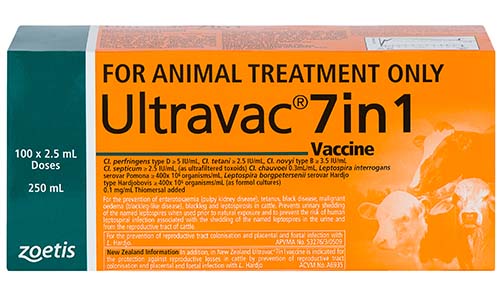
Using Ultravac 7-in-1 from Zoetis according to label directions will ensure that the risk for both cattle and humans is minimised. Ultravac 7-in-1 offers some key advantages:
Ultravac 7-in-1 from Zoetis is the only lepto and clostridial combination vaccine that provides these advantages ensuring that the disease risk is minimised for both cattle and the people that work with them.
| Advantage | Ultravac 7-in-1 | Other 7-in-1 vaccines |
|---|---|---|
| Prevents shedding in urine and from the reproductive tract when used prior to natural exposure. | YES | No claim |
| Prevents reproductive tract colonisation* | YES | No claim |
| Prevents placental and foetal infection* | YES | No claim |
| Calves can be vaccinated from 4 weeks# | YES | 4 to 6 months |
| Low volume 2.5mL dose | YES | 4ml |
| Can be used for up to 30 days after opening** | YES | 24 hours |
References:
1. Erregger, E. et al. The prevalence of Leptospira borgpetersenii sv Hardjo and Leptospira interrogans sv Pomona in Victorian dairy herds. World Buiatrics Congress, Sapporo, 2018.
*Caused by Leptospira borgpetersenii serovar Hardjo.
**Provided storage instructions are followed. Refer to product label for registered label claims.
#The vaccination of calves can begin from 4 weeks of age and is recommended for high- risk properties. When the initial two doses are completed before 3 months of age, an additional dose should be given 6 months later and then annually.
This article was written by Zoetis for Seasons magazine.
Disclaimer - important, please read:
Elders provides recommendations to the best of its knowledge and based on assumptions and information which it understands to be up to date, complete and accurate. If you are aware of any error or inaccuracy with the information on which this recommendation is based, you must immediately bring this to Elders’ attention. This recommendation is provided for your use only, and not that of any other third party. In some circumstances, the information Elders provided may be in summary form or derived from information sourced from third parties, however, Elders has not independently verified the information and cannot guarantee its accuracy.
You should always carefully evaluate all available information and consult Elders or another advisor further before you commit to any course of action or rely on any recommendation. Additionally, Elders expects that you will use your knowledge, experience and best judgement in relying on any recommendation and determining whether the recommendation is, and continues to be, appropriate. Elders do not accept liability or responsibility for any indirect, consequential or economic loss or damage of any kind arising from your acceptance or reliance on this recommendation. To the fullest extent permitted by law, all guarantees, warranties or implied terms and conditions are expressly excluded and Elders’ liability with respect to any services provided is limited to re-supply of the services, or the cost of having the services re-supplied. Elders may from time to time recommend products or services for which it may receive a financial incentive (rebate, commission, benefit, etc) from a supplier/manufacturer directly related to your purchase or use of that product or service.