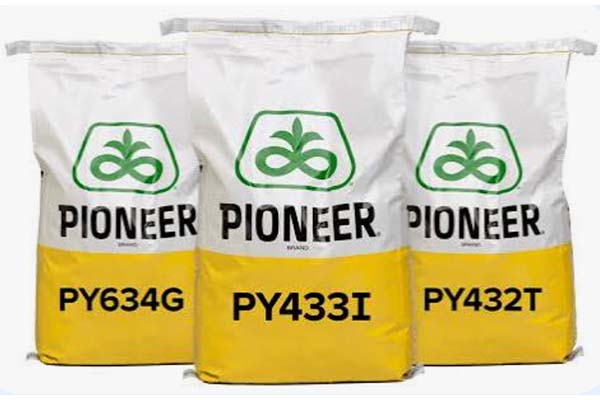
Canola growers continue to face the challenge of balancing maximising yield potential with managing production risks, particularly as disease pressure, seasonal variability and herbicide management challenges evolve across Australian cropping systems.
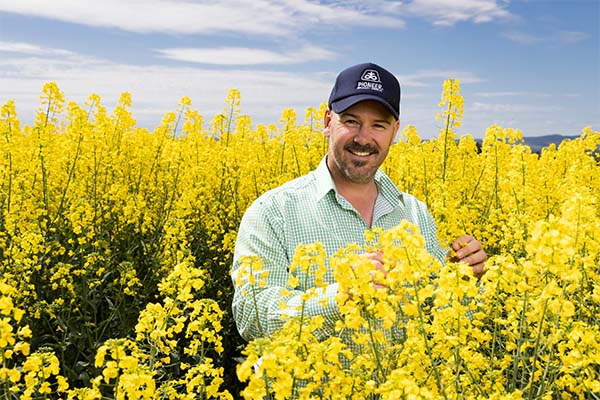 Clint Rogers, Pacific Seeds Canola Portfolio Manager standing in a field of new hybrid canola.
Two new Pioneer® canola hybrids, PY634G and PY433I, have been developed to help growers navigate those challenges, with both hybrids combining strong yield potential with advanced blackleg resistance packages that are tailored to different production environments.
According to Clint Rogers, Pioneer’s Canola Portfolio Manager, disease management remains one of the most important considerations when selecting a canola hybrid.
"Blackleg continues to be one of the most significant diseases impacting Australian canola production, so growers are increasingly looking for hybrids that deliver both productivity and robust disease protection,” Clint said.
"Both PY634G and PY433I combine strong quantitative resistance with effective major gene resistance, giving growers confidence that they're planting genetics with a solid disease defence package while maintaining yield performance."
The new Optimum GLY® hybrid PY634G has been developed for high rainfall production zones where growers are seeking yield stability and superb yield resistance. It features a mid-slow maturity, little to limited vernalisation requirement and strong adaptation to long-season environments.
One of its standout characteristics is its suitability for very early sowing opportunities.
"Early sowing has become an increasingly important management tool for many growers," he said.
"PY634G offers flexibility in those situations, particularly in longer-season environments where growers want to maximise biomass production, extend flowering windows and capture yield potential."
The hybrid also offers strong crop standability and shatter tolerance - characteristics that can help preserve yield when seasonal conditions become challenging leading into harvest.
Pioneer trial data collected across 30 STRIKE trial locations in Western Australia, South Australia, Victoria and New South Wales showed PY634G delivered competitive performance across a wide range of yield environments while maintaining strong yield stability.
For growers operating in shorter-season environments and seeking an imidazolinone-tolerant option, PY433I provides a different set of strengths.
This hybrid has been developed with a fast phenology and modern plant type, featuring dense pod set, strong standability and good shatter tolerance. It also offers vigorous early growth and rapid canopy closure, helping support weed competition and crop establishment.
Importantly, PY433I combines strong blackleg protection with yield performance under seasonal stress.
"PY433I was designed with risk management in mind," Clint said.
"Growers in shorter-season environments often face compressed flowering windows, terminal moisture stress and tight finishes. PY433I provides a package that can perform under those conditions while maintaining excellent disease resistance."
The hybrid is particularly suited to paddocks where blackleg pressure, standability concerns, or seasonal constraints are key management considerations. Across 30 Pioneer STRIKE trial locations conducted during 2024 and 2025, PY433I demonstrated consistent performance and strong yield adaptability. NVT long-term yield comparisons also highlighted its competitive performance relative to current benchmark hybrids in the imidazolinone-tolerant market segment.
While yield remains a key driver of variety selection, Clint believes growers should continue to take a broader view when evaluating hybrids.
"Choosing the right canola hybrid isn't just about top-end yield. Disease resistance, maturity, herbicide tolerance, standability and adaptation to local conditions all contribute to the overall profitability of a crop," he said.
"Whether it's a long-season opportunity with PY634G or a shorter-season scenario where PY433I fits the system, the goal is to match the genetics to the paddock and the management strategy."
This article was written by Pioneer Seeds for Seasons magazine.
Disclaimer - important, please read:
Elders provides recommendations to the best of its knowledge and based on assumptions and information which it understands to be up to date, complete and accurate. If you are aware of any error or inaccuracy with the information on which this recommendation is based, you must immediately bring this to Elders’ attention. This recommendation is provided for your use only, and not that of any other third party. In some circumstances, the information Elders provided may be in summary form or derived from information sourced from third parties, however, Elders has not independently verified the information and cannot guarantee its accuracy.
You should always carefully evaluate all available information and consult Elders or another advisor further before you commit to any course of action or rely on any recommendation. Additionally, Elders expects that you will use your knowledge, experience and best judgement in relying on any recommendation and determining whether the recommendation is, and continues to be, appropriate. Elders do not accept liability or responsibility for any indirect, consequential or economic loss or damage of any kind arising from your acceptance or reliance on this recommendation. To the fullest extent permitted by law, all guarantees, warranties or implied terms and conditions are expressly excluded and Elders’ liability with respect to any services provided is limited to re-supply of the services, or the cost of having the services re-supplied. Elders may from time to time recommend products or services for which it may receive a financial incentive (rebate, commission, benefit, etc) from a supplier/manufacturer directly related to your purchase or use of that product or service.