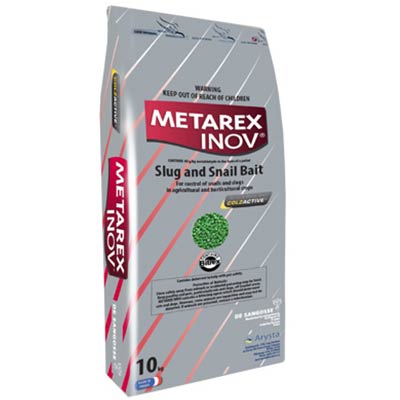
Since 2013, AgNova Technologies Pty Ltd and the Grains Research and Development Corporation (GRDC) have supported ongoing monthly slug monitoring at three sites in southwest Victoria.
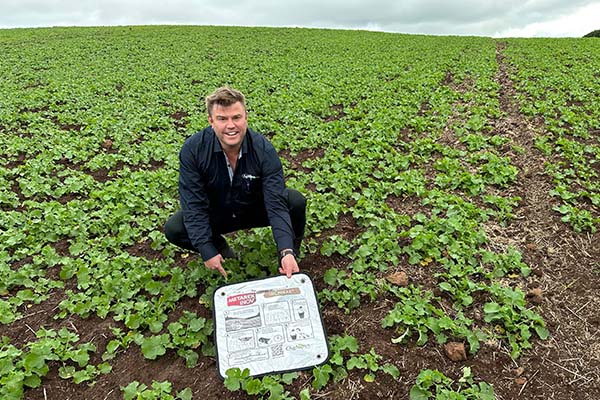 Brad Johnson, area sales manager, with an AgNova Metarex Inov and Ironmax Pro slug and snail monitoring mat.
In response to the unprecedented extent of slug damage in 2023, monitoring has been expanded to areas where slugs have traditionally been a threat. Monitoring also included new areas where slugs caused damage in 2023, for example, northern Victoria and the western slopes of New South Wales.
GRDC monitoring (UOA2308-004RTX) found that slugs were active across several regions despite dry autumn and winter conditions in 2024. Slug communities varied considerably between individual paddocks however. In southwest Victoria, the Wimmera and Western Australia, slugs peaked in June and July. In the Riverina, Eyre Peninsula, and southeast and mid-north of South Australia, slug numbers peaked in late July or August. Black keeled slugs were recorded across all southern Australian sites.
Numbers increased across all sites in late winter/early spring, with the highest populations observed in Eyre Peninsula and southwest Victoria. Subsequent decreases in spring populations were recorded in southwest Victoria, the New South Wales Riverina, and Western Australia after those peaks. These observations support previous results that black keeled slugs are most active and likely to be breeding in late winter and early spring.
No grey field slugs were observed in the New South Wales Riverina, the Fleurieu Peninsula region of South Australa, the Wimmera or Western Australia during 2024. Grey field slugs are active for over a longer period of months compared to black keeled slugs. Grey field slugs were found laying eggs in December at one irrigated site in south-east South Australia. Interestingly, a high proportion of individuals found in several paddocks in southwest Victoria during early spring had ciliate infections, which increase hatchling slug mortality.
These 2024 observations contrast to those following the wet spring in 2022 that favoured slug breeding, with black keeled slugs still laying eggs in late November, leading to extremely high slug populations at crop establishment in 2023.
From this long-term monitoring, it can be concluded that long cool springs favour slug recruitment and reduce juvenile slug mortality.
Slug activity, when crops are emerging, requires a soil water potential to be somewhere towards field capacity. That is, for a clay loam soil type, volumetric soil moisture greater than 25 to 30 per cent (pc). Temperature is an important factor determining slug activity. Slugs are less active when the soil temperature is less than 10 to 12°C. GRDC is supporting the development of models to validate the conclusions presented here and help inform slug risk decision support tools in the future.
In 2024, proactive growers who applied bait after seeding to protect seed and seedlings had no crop losses, even in areas where summer rainfall or irrigation saw slugs active in January. This result could have been due to low populations being less active due to dry establishment conditions, in combination with some bait applied as insurance. Given the dry spring in 2024 and low soil moisture, it is expected that low slug populations will persist into 2025. Furthermore, following two dry springs, the potential for large numbers of black keeled slugs to persist into 2025 is low.
However, slugs observed on the soil surface are only the active proportion of the slug population; the total number is often much greater. This highlights the need to not be complacent and, if soils are at field capacity (35 to 45 pc moisture) when the crop is establishing, a greater proportion of slugs will be at the surface, feeding on seedlings.
For those areas that traditionally experience slugs, despite the expectation of lower numbers of slugs in 2025, if conditions are wet at seeding and establishment of canola is slow, baiting after sowing but before crop emergence is recommended. Use long-lasting baits, such as Metarex Inov, for sustained control where monitoring of establishing crops every three to four days is not possible.
For those areas that are new to slugs, ongoing research is seeking to determine the years where bait needs to be applied, so no recommendations can be made on baiting at present. The question is: can you afford to take the risk of having to resow crops in cold wet conditions?
Real-time monitoring of snails using cameras deployed at Warooka in South Australia indicates juvenile snails are active on dews, trying to rehydrate, but are not showing interest in baits. Conical snails are not taking baits either. The current message has been to roll paddocks to reduce snail numbers in February/March prior to baiting once snails are hydrated and actively feeding, but before egg laying occurs.
Timing of controls is critical for success. In 2025, this may mean baiting once heavy dews and cooler temperatures occur; when round snails are actively feeding in March; and again, later in April, when conical snails are actively feeding. However, in 2024, there were few opportunities to bait conical snails due to the late break. Growers need to monitor the state snails are at and apply bait accordingly, highlighting the importance of the development of real-time monitoring tools.
This article was written by AgNova for Seasons magazine.
Disclaimer - important, please read:
Elders provides recommendations to the best of its knowledge and based on assumptions and information which it understands to be up to date, complete and accurate. If you are aware of any error or inaccuracy with the information on which this recommendation is based, you must immediately bring this to Elders’ attention. This recommendation is provided for your use only, and not that of any other third party. In some circumstances, the information Elders provided may be in summary form or derived from information sourced from third parties, however, Elders has not independently verified the information and cannot guarantee its accuracy.
You should always carefully evaluate all available information and consult Elders or another advisor further before you commit to any course of action or rely on any recommendation. Additionally, Elders expects that you will use your knowledge, experience and best judgement in relying on any recommendation and determining whether the recommendation is, and continues to be, appropriate. Elders do not accept liability or responsibility for any indirect, consequential or economic loss or damage of any kind arising from your acceptance or reliance on this recommendation. To the fullest extent permitted by law, all guarantees, warranties or implied terms and conditions are expressly excluded and Elders’ liability with respect to any services provided is limited to re-supply of the services, or the cost of having the services re-supplied. Elders may from time to time recommend products or services for which it may receive a financial incentive (rebate, commission, benefit, etc) from a supplier/manufacturer directly related to your purchase or use of that product or service.