Blowfly strike is estimated to cost the industry almost $324 million each year, with $227 million of this due to production losses.1 Flystrike is primarily caused by the Australian sheep blowfly, Lucilia cuprina.
Adult female blowflies lay their eggs in the moist wool of susceptible sheep. After hatching, maggots progress through three larval stages before dropping from the sheep to pupate in the soil.
Depending on seasonal conditions, the entire lifecycle can be completed in just two to three weeks, meaning blowfly numbers can increase rapidly if susceptible sheep are available.
The onset of cooler conditions at the end of the fly season prevents the development of pupae, which are inhibited (or ‘arrested’) at the prepupae stage.
Elanco Brand Manager – Sheep, Dave Rathbone, said pupal development recommences once soil temperature begins to rise in spring.
“In south-eastern Australia, the first generation of flies tends to emerge at the same time, regardless of when the larvae were deposited,” he said.2
“Fly numbers can build up rapidly under suitable environmental conditions if susceptible sheep are available.”
Treatment with an effective chemical early in the season can reduce the build-up of the blowfly population and the risk of blowfly strike later in the season.3,4
“Applying a chemical treatment before blowflies emerge removes sheep as a breeding resource for the first generation of flies,” Dave said.
“Strategically timed shearing or crutching will further reduce the susceptibility of sheep to flystrike.”
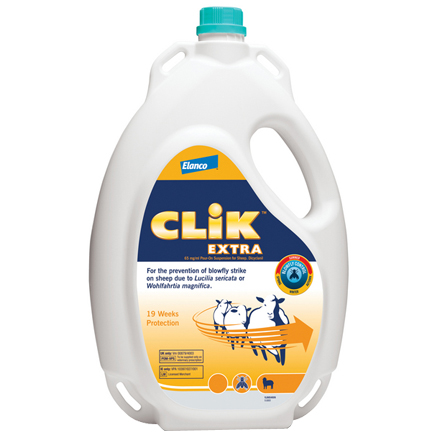
Most sheep and wool producers apply a preventative treatment at the same time each year, typically using a spray-on treatment, such as CLiK™ Extra.5,6
Applied to sheep off-shears or with any length wool, CLiK Extra protects against blowfly strike for up to 29 weeks.7
It can also be applied to protect mulesing and marking wounds against blowfly strike.7
CLiK Extra contains 65 g/L dicyclanil, the same proven active ingredient in CLiK Spray-On.
Dicyclanil is a powerful insect growth regulator that breaks the life cycle of blowflies by preventing first stage larvae from developing into damaging second-stage maggots.
“CLiK Extra contains 30 per cent more dicyclanil than CLiK and provides up to five weeks’ longer protection against blowfly strike,” Dave said.8
“Its two-band application technique for sheep weighing more than 30 kg provides extra protection against breech strike8,9 the most common site of blowfly strike in typical years.”10,11
CLiK Extra provides extra protection against development of resistance where it remains above the minimum effective concentration (MEC) throughout the entire season and until flies are no longer active. This will also reduce the need for re-treatment within the same fly season.8,9,12
“All told, CLiK Extra provides extra peace of mind, knowing that your sheep are protected against blowfly strike for up to 29 weeks,” Dave said.
“That gives you the option to treat early whilst still providing season-long protection.”
Dicyclanil was discovered in the 1980s by Ciba-Geigy, which later became Novartis Animal Health. Elanco acquired Novartis in 2015. In-vitro and in-vivo tests indicated this molecule was significantly more potent than cyromazine, the active ingredient in Vetrazin®, and provided significantly longer protection against blowfly strike.13
Research continued throughout the 1990s and CLiK was registered for use in Australia in 1998, followed by CLiKZiN™ (12.5 g/L dicyclanil) in 2009 and CLiK Extra in 2017.
Dave said Elanco is continuing to develop new solutions to prevent and control blowfly strike at its Yarrandoo research facility in western Sydney.
“Yarrandoo is the only private-sector animal health R&D facility in Australia,” he said.
“It has played key role in the development of the CLiK portfolio and more recently, the development of Zolvix™ Plus broad-spectrum drench for sheep and cattle.
“Elanco is committed to developing new solutions that improve the health and well-being of animals – and helping our customers to get the best results from their investment in quality animal health solutions.
“Our team of regionally based representatives and technical advisors provide a range of practical, on-farm advice and support, including best practice guidelines, application training, applicator servicing and diagnostic services.”
Always read and follow the label directions. Good agricultural practice is essential for optimal blowfly strike prevention.
CLiK Extra Spray-On contains 65 g/L dicyclanil and provides up to 29 weeks protection from blowfly strike. Wool WHP: 3 months. Meat: WHP 21 days. ESI: 9 weeks. CLiK Spray-On contains 50 g/L dicyclanil and provides 18–24 weeks protection from blowfly strike. Wool WHP: 3 months. Meat WHP 28 days. ESI: 9 weeks.
This article was written by Dave Rathbone, Elanco Brand Manager - Sheep for Seasons magazine.
References: 1. Shephard, R. et al. (2022). Priority list of endemic diseases for the red meat industry – 2022 Update. Meat & Livestock Australia. Report B.AHE.0327.
2 DeCat, S. et al. (2012). Survival over winter and spring emergence of Lucilia cuprina (Diptera Calliphoridae) in south-eastern Australia. Aus J of Entomology.
3. McKenzie, J.A. & Anderson, N. (1990). Insecticidal control of Lucilia cuprina: strategic timing of treatment. Aust Vet J 67:385–386.
4. Larsen, J.W. et al. (2012). Prevalence of breech-strike in mulesed, clipped and unmulesed Merino hoggets in south-eastern Australia. Aust Vet J 90(5):158–166.
5. Reeve, I. & Walkenden-Brown, S. (2014). Benchmarking sheep parasite control. Cross sectional survey report. B.AHE0669. Australian Wool Innovation Limited & Meat & Livestock Australia.
6. Colvin, A.F. et al. (2020), Benchmarking Australian sheep parasite control practices: a national online survey, Animal Production Science, 61(3), pp. 237–245.
7. Refer to registered label.
8. Compared to CLiK.
9. When used for prevention against breech strike, or body and breech strike.
10. Wardhaugh, K.G. et al. (2001). Factors affecting the incidence of flystrike in sheep – a description and analysis of data from three separate areas in eastern Australia. Proceedings of FLICS – Flystrike and lice IPM control strategies – a national conference, Launceston, Tasmania, 25–27 June 2001.
11. Tyrell, L.D. et al. (2014). Breech-strike on mulesed, clipped and unmulesed Merino ewes and hoggets in southeastern Australia. Aust Vet J 92(9):348–356.
12. Insecticide resistance in sheep blowfly larvae, Sheep CRC, FlyBoss 2021.
13. Bowen, F.L. et al. (1999). Long-lasting prevention against blowfly strike using the insect growth regulator dicyclanil. Aust Vet J 77:454-460.
Disclaimer - important, please read:
Elders provides recommendations to the best of its knowledge and based on assumptions and information which it understands to be up to date, complete and accurate. If you are aware of any error or inaccuracy with the information on which this recommendation is based, you must immediately bring this to Elders’ attention. This recommendation is provided for your use only, and not that of any other third party. In some circumstances, the information Elders provided may be in summary form or derived from information sourced from third parties, however, Elders has not independently verified the information and cannot guarantee its accuracy.
You should always carefully evaluate all available information and consult Elders or another advisor further before you commit to any course of action or rely on any recommendation. Additionally, Elders expects that you will use your knowledge, experience and best judgement in relying on any recommendation and determining whether the recommendation is, and continues to be, appropriate. Elders do not accept liability or responsibility for any indirect, consequential or economic loss or damage of any kind arising from your acceptance or reliance on this recommendation. To the fullest extent permitted by law, all guarantees, warranties or implied terms and conditions are expressly excluded and Elders’ liability with respect to any services provided is limited to re-supply of the services, or the cost of having the services re-supplied. Elders may from time to time recommend products or services for which it may receive a financial incentive (rebate, commission, benefit, etc) from a supplier/manufacturer directly related to your purchase or use of that product or service.