
As part of the Australian Citrus Growers Study Tour to South Africa, Elders agronomist Emily May gained a first-hand look at how growers on the other side of the world are managing citrus production.
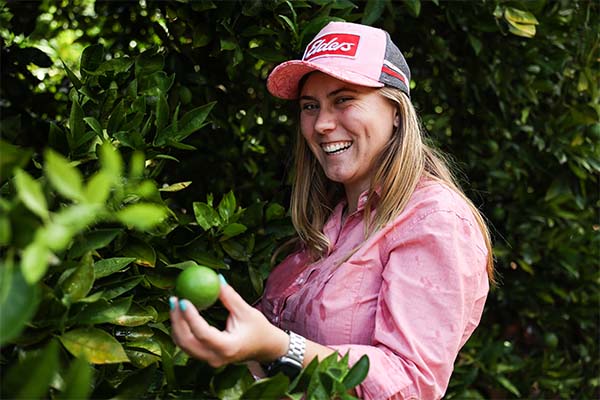
Working in Griffith as a horticultural agronomist, Emily has spent the past four years supporting citrus growers across the region. She joined Elders five and a half years ago, starting out as a sales support officer at Ace Ohlsson in Sydney before moving through the Graduate Agronomy Program.
Her interest in agronomy began back in high school while working in her neighbour’s citrus orchard.
“We were on the outskirts of Sydney and struggled to find agronomists who were willing to travel or specialise in citrus,” said Emily.
“I started to see it as an opportunity. If there aren’t many people doing this role, why not become the person to fill the gap?”
That drive has shaped Emily into a successful horticultural agronomist working for Elders throughout the Riverina. Recently, she took a trip to South Africa as part of the Australian Citrus Growers Study Tour. She joined growers and industry professionals from across Australia to see first-hand how South African producers approach citrus farming. She described the experience as eye-opening.
“What surprised me most was how labour intensive everything was,” she said.
The tour group visited Unipack Fruit in Ashton, Western Cape. The company is a leading soft citrus exporter in South Africa, packing over 120,000 cartons annually, with 70 per cent of the fruit sourced from shareholder farms.
“In the packing sheds, fruit was still being packed by hand, pruning was manual, and fertiliser was being applied by over 100 people with buckets and cups, despite fertigation systems being in place.” Emily explained.
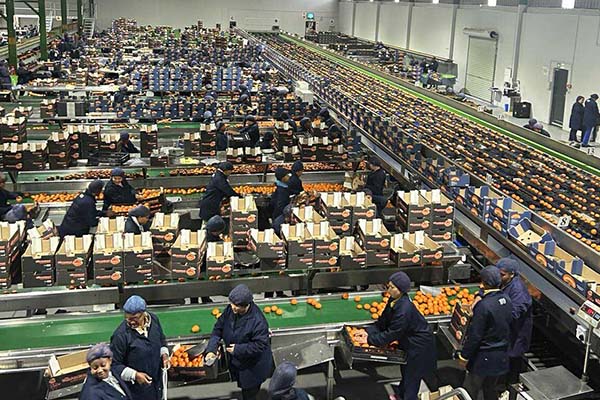 Looking down and across the packing area at Unipack Fruit.
The reason, she learned, wasn’t a lack of technology but a reflection of the country’s social and economic conditions.
“With unemployment at over 42 per cent, employing people for even the most basic jobs is seen as almost a civic duty." On a 200-hectare farm, it wasn’t unusual to see 1,000 to 3,000 workers, like the picker at Denau Packing’s orchards in the Breede Valley, Western Cape, shown opposite.
The group also observed some of the strict measures South African growers must take to access export markets.
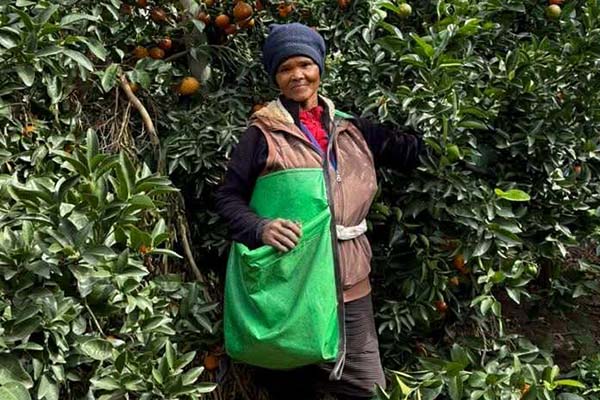 A picker at Denau Packing’s orchards. She happily posed for a photo, joking in broken English that the shot might make her “Instagram famous.”
“Their pest complex is much stricter, especially with exports going to the EU,” she said.
“False Codling Moth, which we thankfully don’t have in Australia, means they need huge in-paddock controls followed by cold sterilisation at minus 0.6°C for 22 days before fruit can be shipped.”
Another striking difference was security.
“Every property we visited had razorwire, electric fences, armed guards and checkpoints.
“It wasn’t just around the boundaries either, some farms had their land divided into internal zones with their own security.”
Despite these challenges, Emily said there were also similarities with Australian production.
“Climatically we farm in very similar conditions, with their season about three weeks ahead of ours,” she said.
“The biggest learning for me was around inputs, their approach is that you need to put the inputs in if you expect results.
“Seeing how they manage water on really light soils also made me think about how we might adjust irrigation and fertiliser practices here on our heavier soils.”
One of the standout visits for her was Enduleni Farms in Patensie in the Eastern Cape.
“As a young woman in the citrus industry, I don’t often see many others in similar roles in our local area,” she said.
“At Enduleni, most of the sector managers we met were young women, and their own managers really championed them. It was inspiring to see and made me appreciate that I’m not on my own little ‘island’ in the global industry.”
Looking back, Emily says the tour was both a professional and personal milestone.
“I’d go back in a heartbeat,” she said.
“It’s a beautiful country with stunning landscapes and a wonderful culture. There were things that shocked me, but it reminded me how lucky we are in Australia and not to take our creature comforts for granted.”