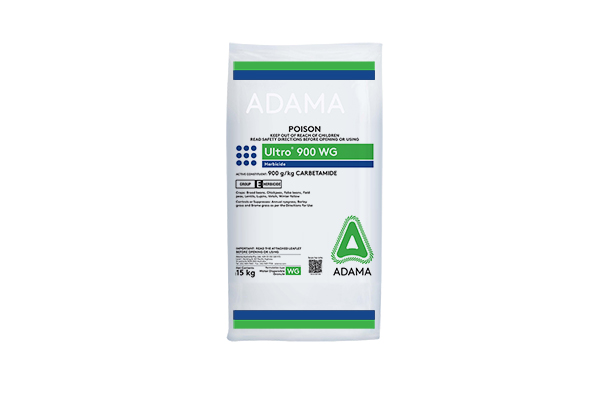
Stronger herbicide options in pulse crops are proving to be highly effective for control of grass weed populations and are offering valuable extra benefits for entire cropping systems.

Many Western Australian growers have targeted the use of Ultro® pre-emergent herbicide in lupins, as an alternative to propyzamide applications for ryegrass, brome and barley grass control, due to its robust efficacy and significant benefits for their whole farm weed management plans.
Critically, Ultro has offered a new herbicide mode of action (Group 23). In addition to lupins, it can be used in faba beans, lentils, field peas, chickpeas, vetch and broad beans across Australia, as well as in winter fallow.
“It’s been as good or better than propyzamide and as an alternative herbicide group, it can then allow growers to make suitable propyzamide applications in the canola phase of their programs,” said Bevan Addison, Market Development Manager with ADAMA Australia in WA.
“The interest in Ultro for barley grass has also grown, because grass selective sprays are not performing as well against various populations and it can reduce the pressure on these herbicides.”
Bevan said after recognising the benefits of Ultro for grass control in their pulse crops and for their broader cropping system, growers were now driving its use and rate of application, with higher rates tending to be used on heavier soil types.
“Ultro is a high value herbicide, but it’s the benefits it provides to the whole cropping system that are being appreciated by growers.
"With pulse crops, growers want to make some money where they can, but they also want the nitrogen fixation, they want a disease break and they want to remove weeds.
“As part of the full system, Ultro is showing it does this better than anything else and it results in reduced panicles and seedset. It achieves earlier control of weeds – many simply don’t come out of the ground – and this also reduces root disease build-up for following seasons.
“Earlier control removes any competition and the crop also gets up and away and provides its own competition. Excellent root pruning on the remaining grasses later also means growers can do a final mop-up with a grass selective like Platinum® Xtra 360 and achieve a proven yield benefit.”
He said Ultro-treated grass weeds can also remain greener for longer and in particularly high weed pressure paddocks requiring crop-topping, this allows these applications to be delayed, reducing the risk of crop damage from the operation and concern over grain maximum residue limits.
Seasonal conditions have varied greatly in recent seasons and during the dry 2023 year compared with other herbicides, Ultro performed extremely well across different soil types and its good residual control resulted in reduced requirement for post-emergent, “clean-up” treatments. Last season, conditions ranged from wet to quite dry in different areas and Ultro continued to achieve excellent results.
“Ultro is more soluble than alternatives, so in dry conditions it activates and provides better weed control,” Bevan said.
“It also results in severe root pruning of later germinations, so growers are then able to achieve better control from their standard grass selective brews.
“Last year I spent quite a bit of time in South Australia, which experienced a drier, WA wheatbelt type season, and, for the first time, many people have seen how Ultro performs relative to other options in the drier conditions.”
Tristan Clarke, who farms with his family at Bolgart, said numerous growers in the Dalwallinu area were using Ultro as an alternative to propyzamide in lupins and were achieving great results.
“It’s a good opportunity for growers to use something different in their chemical rotation strategy and its performance in-crop has been phenomenal for everyone that has used it,” Tristan said.
“One of Ultro’s biggest benefits in my eyes is that it takes a bit less rainfall to activate. In seasons where we have dry starts, or for lower rainfall growing regions, that’s where it really does have a good fit.”
Bevan said to aid herbicide resistance management, ADAMA Australia recommended limiting the use of Ultro to once every four years.
He said in tight cropping rotations, careful consideration would need to be given to herbicide choice, however in more common rotations featuring pulses, canola and cereals, an application every four years would be easy to achieve and would allow rotation of all herbicide options in the different phases.
This article was written by ADAMA Australia for Seasons magazine.
Disclaimer - important, please read:
Elders provides recommendations to the best of its knowledge and based on assumptions and information which it understands to be up to date, complete and accurate. If you are aware of any error or inaccuracy with the information on which this recommendation is based, you must immediately bring this to Elders’ attention. This recommendation is provided for your use only, and not that of any other third party. In some circumstances, the information Elders provided may be in summary form or derived from information sourced from third parties, however, Elders has not independently verified the information and cannot guarantee its accuracy.
You should always carefully evaluate all available information and consult Elders or another advisor further before you commit to any course of action or rely on any recommendation. Additionally, Elders expects that you will use your knowledge, experience and best judgement in relying on any recommendation and determining whether the recommendation is, and continues to be, appropriate. Elders do not accept liability or responsibility for any indirect, consequential or economic loss or damage of any kind arising from your acceptance or reliance on this recommendation. To the fullest extent permitted by law, all guarantees, warranties or implied terms and conditions are expressly excluded and Elders’ liability with respect to any services provided is limited to re-supply of the services, or the cost of having the services re-supplied. Elders may from time to time recommend products or services for which it may receive a financial incentive (rebate, commission, benefit, etc) from a supplier/manufacturer directly related to your purchase or use of that product or service.