
More than a quarter of a century supporting brassica growers provides strong qualifications to comment on insect management trends. One man with such qualifications is Elders Horticultural Agronomist Greg Teske.
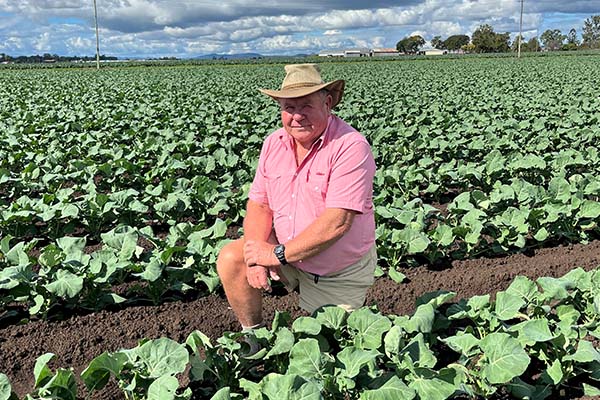
Greg said that before the recent arrival of an insecticide with a new growth regulant in the Lockyer Valley in Queensland, areas of the region were hitting the wall with pest control.
In his role Greg services the Lockyer Valley, and also assists some local growers who grow brassica crops during summer in the cooler Darling Downs area, south-west of Toowoomba.
The major brassica crops grown in the regions include broccoli, broccolini, cauliflower and red and green cabbages.
Greg said it was an overuse of Group 28 insecticides and lack of rotation with other chemistry groups that caused concerning insecticide resistance in various areas, particularly with diamondback moth (DBM). Other insects to contend with include heliothis, centre grub, cabbage cluster caterpillar, cluster caterpillar and cabbage white butterfly.
“Chlorantraniliprole was used as a plant hole drench or treatment for seedlings and had a claim to persist for 40 days, but of course it gets weaker towards the end, and then flubendiamide or additional chlorantraniliprole was used,” Greg said.
Fortunately, he said, Plemax insecticide then arrived and it was a pivotal turning point for insecticide resistance management throughout the region.
Developed by ADAMA Australia, Plemax is a dual mode of action insecticide containing the well-proven active ingredient, indoxacarb (Group 22A), however Greg said the real winner was its combination with the growth regulant, novaluron (Group 15).
“Indoxacarb is still far better than some biological insecticides because it lasts longer, and the novaluron does not exist in other chemistry being used,” Greg said.
“I was involved with the early trials of Plemax, and the control was outstanding compared with that from other standard insecticides at the time.
“We saw that it would be great used in rotation with other chemistry like spinetoram and emamectin benzoate.”
He said Plemax had since become a regular fixture in insect management programs in rotation with other chemistry groups. It had dramatically improved resistance levels and, hence, reduced the applications required in programs. It had helped to save some existing insecticides coming under increasing pressure, and it was now rotating well with some latest Group 30 insecticides to further improve control.
“Plemax gave us a product with longer legs – it immediately improved the activity on pests over a longer period.”
“Indoxacarb is weaker on insects like cabbage cluster caterpillar after some strong use of the single insecticide, but the novaluron in Plemax targets them, so we have a broad range of pests we can control.”
Greg said against DBM, application at the optimum time, just prior to eggs hatching, was “absolutely critical”.
“When you get the timing right, you generally won’t have an escape. And if you are late, perhaps due to rain, you still put Plemax on and the novaluron will pick up the larvae. Having the novaluron with the indoxacarb is like having insurance.”
He said it was important to correctly identify and understand pests and their life cycles, the full scope of product applications in brassica crops, and climate factors.
“In warmer months, the life cycles are so quick. It can be five days from laying to hatching. In winter, that life cycle is then doubled.
“You also have to watch rain events because then you may not be able to get onto paddocks and the pest pressure can go from low to high.
“My motto has been to apply early for best results and most growers now understand this. If you go early, and when Plemax has its best fit, you get in front of the pest, control them early and you don’t have too many issues further forward. If you see the eggs are going to hatch in three days, spray in two days’ time.
“It’s all about monitoring to use the insecticide effectively. We have got brilliant chemistry and if we don’t abuse it, we will have it for a lifetime.”
Greg said he generally advised that if insect pressure was moderate to high, the 300 mL/ha rate of Plemax should be applied up to three times per crop, in conjunction with rotating other chemistry groups into programs according to the particular pest.
He said crop safety with Plemax also had been excellent and there had been no need to mix other chemistry groups with the insecticide.
“For centre grub and DBM, we have used Plemax back-to-back and that’s all that’s been needed with the application. We then go to a different active (ingredient).”
This article was written by ADAMA Australia for Seasons magazine.
* Disclaimer – Important, please read:
The information contained in this article is given for general information purposes only, current at the time of first publication, and does not constitute professional advice. The article has been independently created by a human author using some degree of creativity through consultation with various third-party sources. Third party information has been sourced from means which Elders consider to be reliable. However, Elders has not independently verified the information and cannot guarantee its accuracy. Links or references to third party sources are provided for convenience only and do not constitute endorsement of material by third parties or any associated product or service offering. While Elders has exercised reasonable care, skill and diligence in preparation of this article, many factors including environmental/seasonal factors and market conditions can impact its accuracy and currency. The information should not be relied upon under any circumstances and, to the extent permitted by law, Elders disclaim liability for any loss or damage arising out of any reliance upon the information contained in this article. If you would like to speak to someone for tailored advice specific to your circumstances relating to any of the matters referred to in this article, please contact Elders.