
Elders is committed to the priorities in our Sustainability Framework. These include addressing climate-related risks and opportunities, supporting farmers’ productivity through sustainable land management, and tailoring waste management practices to our business activities.
Hotter and drier conditions, prolonged droughts and increased extreme weather events have profound effects across our business.
We are committed to managing emissions in our operations. We are developing targeted strategies of adaptation that address the specific climate-related risks and opportunities for our business.
Target | Progress |
2025 100 percent renewable electricity in all Australian sites by 2025. | Target maintained through onsite solar generation and LGC procurement and retirement. |
2030 50 per cent reduction in Scope 1 and 2 emissions intensity (tCO2e/$m revenue) by 2030, against a baseline year of 2021. Subject to commercially available technology being available to address feedlot cattle emissions. | FY21 - FY24: 23 per cent reduction in emissions intensity relative to our baseline achieved FY25: Emissions Intensity: 11.9 tCO2e/$m revenue 2.Elders’ FY25 results are not directly comparable to the FY21 baseline and FY22 - FY24 emissions intensities as in FY25, the Department of Climate Change, Energy, the Environment and Water (DCCEEW) introduced an Australian-specific methodology for calculating enteric methane emissions from grain-fed cattle. This update resulted in a methodological change to how Killara Feedlot’s Scope 1 GHG emissions are calculated. For more information see page 25 Sustainability Report. |
2050 Net zero Scope 1 and 2 emissions by 2050. | 38,206 tCO2e total Scope 1 and 2 emissions in 20252 |
Our emissions profile for FY25 is made up of three key categories:
*The Killara Feedlot was sold in June 2026. Killara was included in our FY25 emissions footprint and will remain part of our FY26 reporting up to the date of sale.
**Other includes other fleet transport fuels (gasoline, LPG) and stationary fuels (diesel, natural gas, LPG and gasoline).
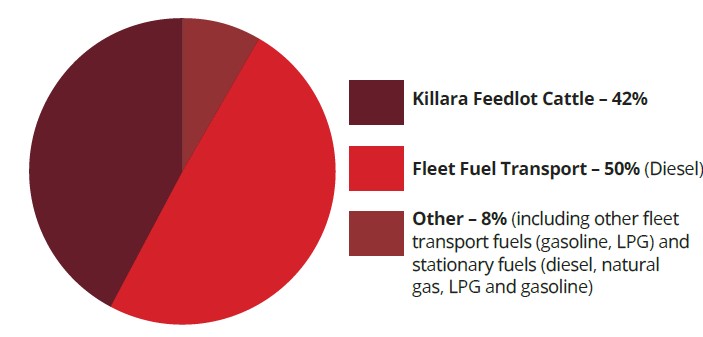 Pie graph showing contributors to Elders emissions in 2025
There is a growing need for sustainable farming practices to manage natural resources efficiently while promoting social and economic wellbeing.
We support farmers’ productivity through the introduction of innovative technologies that facilitate sustainable land management.
In collaboration with industry bodies, universities, and governments, Thomas Elders Sustainable Agriculture (TESA) enables us to champion future-focused solutions.
It is our responsibility to properly manage our waste and support effective waste management in our supply chains. Our primary waste footprint comprises product packaging and livestock, including organic waste produced by cattle at our Killara Feedlot.
We are members of Australian Packaging Covenant Organisation (APCO) which guides our ambition to reduce the packaging waste, in line with the 2025 National Packaging Targets. Download and read our 2025 APCO Annual Report and Action Plan and refer to our Waste Policy for more information.
We are members of bagMuster and Big Bag Recovery, facilitating the recycling of plastic bags from the rural products supply chain.
Our management practices are tailored in response to the business activities undertaken within our network. Where possible, we recover, reuse or recycle our waste to maintain circularity, through participation in schemes including drumMUSTER and Big Bag Recovery.
Further initiatives in environmental sustainability are outlined in our Sustainability Report.
/four_staff_by_waterchannel.jpg)