Elders Business Intelligence Analyst Richard Koch discusses his data driven forecast for the Australian sheepmeat market this spring and the factors influencing it.
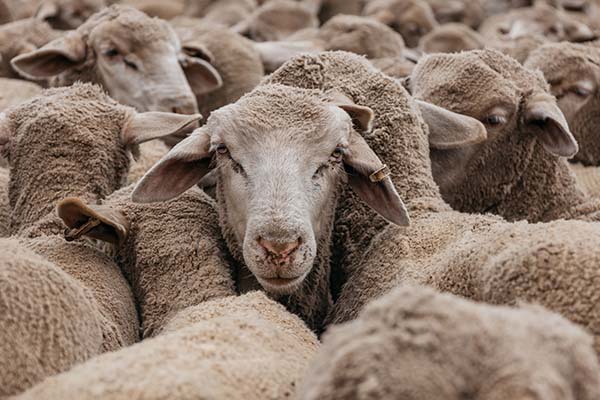
The Australian lamb processing sector has done a good job of managing low sheepmeat supply by regulating production to fit lower levels of demand at historically high prices.
Slaughter bottomed at multi-year lows during July as several plants shut for seasonal maintenance or operated on reduced shifts due to the tight availability of stock and high acquisition prices. National lamb slaughter is down by 13 per cent (pc) so far during 2026 which has supported values across the lamb complex.
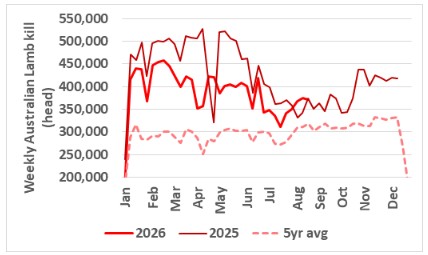 This chart shows weekly lamb slaughter in 2026 vs 2025 and five-year average. Source: MLA.
Solid processor competition for suitable slaughter lambs, particularly for well-finished trade and export lambs have supported prices around historic highs through the winter quarter. The past month has seen the reversal of spreads to favour trade and heavy lambs as supplies of new season store lamb supplies increased. In addition, export market conditions for lighter lambs toughened with the ongoing regional conflict in the Middle East and resistance to higher lamb costs in price sensitive markets across Asia.
Lamb prices matched our forecasts for most of the winter quarter, however by the end of the quarter, values for light and restocker lambs eased. This happened with the early arrival of new season lambs which are running around a month ahead of expectations. It is expected that graziers will continue to market lambs early and at lighter weights to capitalise on higher prices.
The prospect of increased supplies of new season store lambs in coming months has reduced restocker and feeder urgency with those wanting stock to graze winter fodder crops having already purchased. The appetite for feeders to compete with restockers is waning with most expecting that slaughter lamb prices will ease through the spring quarter as a larger supply of new season slaughter weight lambs hit the market.
Mutton kills have been very constrained for much of the year – falling 38 pc year to date - as improved seasonal conditions across key lamb producing areas and relatively high wool and lamb returns have encouraged producers to rebuild.
Given the reduction in core breeding numbers the past few years, the current flock has a relatively young profile, limiting availability of cull ewes. Although mutton supplies remain tight, with the improved seasonal conditions, sheep offered for slaughter have been at higher weights which has brought values back off their peak.
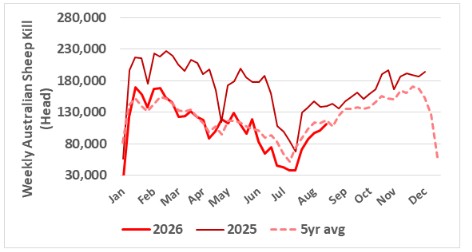 This chart shows weekly mutton slaughter in 2026 vs 2025 and five-year average. Source: MLA.
With reduced supply it has been tough going in export markets. For the year so far, total lamb exports are down 11 pc with export market demand curtailed by high relative cost. Volumes to most markets outside Asia and the UK have fallen with the largest declines in markets across the Middle East region (-31 pc) and in price sensitive markets such as PNG (-52 pc). High prices have even checked demand in premium markets such as the US.
In the US, a sharp reduction in domestic supply, coupled with high beef prices, has significantly boosted US lamb prices. Given high lamb costs Australia our export lamb offers have also risen in the curtailing export volumes which have fallen by 12 pc year to date.
The story is much the same in mutton markets with falls in volumes across the board of 39 pc. Only Japan and Canada have increased imports with other markets down generally between 30 to 50 pc.
The table below shows the Australian Saleyard Indicator Prices (ac/kg cw), bith actual (a) and forecast (f) based on sales in June so far. Source: Meat and Livestock Australia (MLA) & Elders forecasts & projections.
| June (a) | June (f) | July (a) | July (f) | Aug (a) | Aug (f) | |
|---|---|---|---|---|---|---|
| Heavy lambs | 1128 | 1100 | 1141 | 1150 | 1114 | 1150 |
| Trade lambs | 1214 | 1150 | 1215 | 1200 | 1172 | 1200 |
| Restocker lambs | 1209 | 1200 | 1195 | 1225 | 1106 | 1225 |
| Mutton | 871 | 800 | 898 | 800 | 835 | 800 |
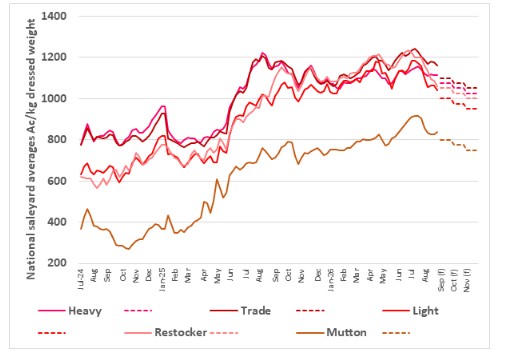 This chart shows national saleyard price averages by category. Source: Meat & Livestock Australia (MLA), Elders forecasts (f).
The outlook is for increased new season lamb supplies with the better season affording much improved lambing rates and higher weaning weights. This will see larger, heavier and earlier lamb supplies than in previous seasons. Expect store and processing lamb supplies to begin increasing in northern and western lamb regions from September with prices expected to follow the normal seasonal pattern of easing through spring.
There remains a deal of uncertainty around the extent of flock rebuilding this season. While there will be a move from some producers towards rebuilding given the improved relative profitability of sheep enterprises, expect the extent to be limited by the high sheepmeat prices on offer and seasonal uncertainty due to forecasts for a strong El Nino. High prices and cash flow needs will encourage a steady flow of store lambs with the timing to be determined by spring weather. It is likely that the flock rebuild will be slower than in previous cycles which should aid lamb supplies through the upcoming spring quarter.
Overall, the industry outlook remains positive supported by lower flock numbers and positive structural changes such as the increase in containment feeding and lamb feedlots.
This is becoming a more permanent feature of the industry, supporting heavier carcase weights, more consistent supply and improved flock productivity, while also increasing competition for lighter lambs and adding pressure to processor margins.
In a global context, New Zealand’s smaller flock is expected to keep global sheepmeat supply tight, creating export opportunities for Australia. However, high relative sheepmeat costs, Middle East trade disruptions and ongoing freight and input cost pressures, are likely to affect competitiveness and export demand through 2026, constraining prices across the sheepmeat complex to below recent levels.
The table below shows Australian Saleyard Indicator Prices (c/kg cw), both actaual and forecast (f). Source: Source: Meat and Livestock Australia (MLA) & Elders forecasts.
| May | June | July | Aug | Sep (f) | Oct (f) | Nov (f) | |
|---|---|---|---|---|---|---|---|
| Heavy lambs | 1093 | 1128 | 1141 | 1114 | 1075 | 1050 | 1025 |
| Trade lambs | 1165 | 1214 | 1215 | 1172 | 1100 | 1075 | 1050 |
| Light lambs | 1099 | 1141 | 1143 | 1057 | 1000 | 975 | 950 |
| Restocker lambs | 1159 | 1209 | 1195 | 1106 | 1050 | 1025 | 1000 |
| Mutton | 795 | 871 | 898 | 835 | 800 | 775 | 750 |
Disclaimer - important, please read:
Elders provides recommendations to the best of its knowledge and based on assumptions and information which it understands to be up to date, complete and accurate. If you are aware of any error or inaccuracy with the information on which this recommendation is based, you must immediately bring this to Elders’ attention. This recommendation is provided for your use only, and not that of any other third party. In some circumstances, the information Elders provided may be in summary form or derived from information sourced from third parties, however, Elders has not independently verified the information and cannot guarantee its accuracy.
You should always carefully evaluate all available information and consult Elders or another advisor further before you commit to any course of action or rely on any recommendation. Additionally, Elders expects that you will use your knowledge, experience and best judgement in relying on any recommendation and determining whether the recommendation is, and continues to be, appropriate. Elders do not accept liability or responsibility for any indirect, consequential or economic loss or damage of any kind arising from your acceptance or reliance on this recommendation. To the fullest extent permitted by law, all guarantees, warranties or implied terms and conditions are expressly excluded and Elders’ liability with respect to any services provided is limited to re-supply of the services, or the cost of having the services re-supplied. Elders may from time to time recommend products or services for which it may receive a financial incentive (rebate, commission, benefit, etc) from a supplier/manufacturer directly related to your purchase or use of that product or service.