Elders Business Intelligence Analyst Richard Koch discusses his data driven forecast for the Australian sheepmeat market this autumn and the factors influencing it.
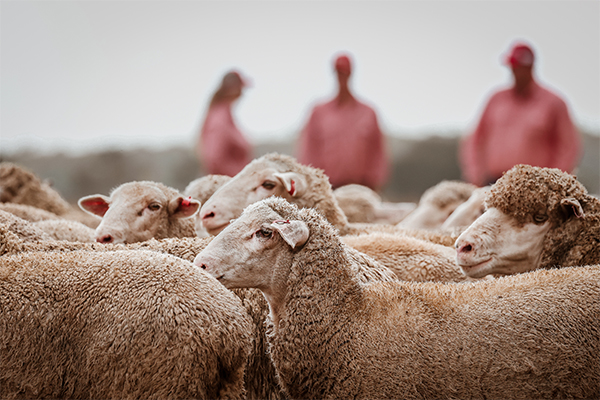
A generational weather event through pastoral areas of South Australia and New South Wales (NSW) that delivered rainfall to most of the south-east has tightened supply and created some processor buying urgency, leading an appreciation in in sheepmeat values during March.
Lambs have moved to an all-time high trading range between $11 to $12/kg dressed weight (dw) and sheep to $7.50 to $8/kg dw. This has pushed values 50 cents to $2/kg cw above our summer price forecasts. Pastoral areas that have been a major source of supply for the processors and southern feeders have effectively closed the gate to rebuild numbers, turning them from sellers to buyers, contributing to price strength across restocker and light lamb categories.
The export sector has done a good job of managing lower supply through its seasonal peak demand period (Ramadan, Eid Australian dollar Greek Easter during the first quarter of 2026). Lamb exports for the year are down just (-3 per cent) which suggests that supply is being diverted away from the domestic market to higher paying export markets.
While overall lamb export volumes are holding up, performance across key export regions has been mixed. Higher export volumes to Europe (up 19 per cent) and Asia (up 15 per cent) have offset lower volumes to North America (down 12 per cent) and Middle East (down 22 per cent). Uneven export performance illustrates that demand for Australian lamb is being negatively influenced by historically high price levels and a higher Australian dollar with processors and exporters reporting some customer price fatigue. Issues with supply routes into the Middle East has reduced processor demand for light lamb which has seen restockers and feeders active on these lambs, supporting values.
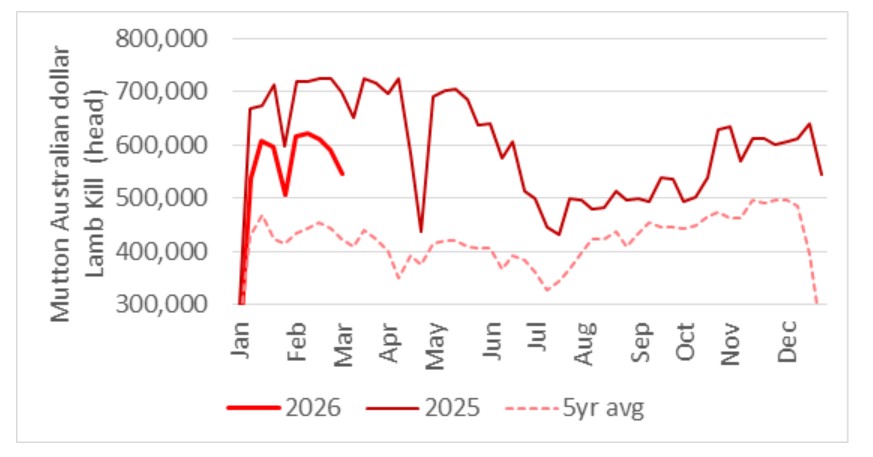 This chart shows Australian weekly sheepmeat slaughter in 2025 vs 2026 Australian dollar the 5-year average. Source: NLRS
Owing to sharply lower mutton slaughter (down 29 per cent year on year), prices paid by processors for mutton has strengthened in recent weeks as works seeks to fill slaughter schedules.
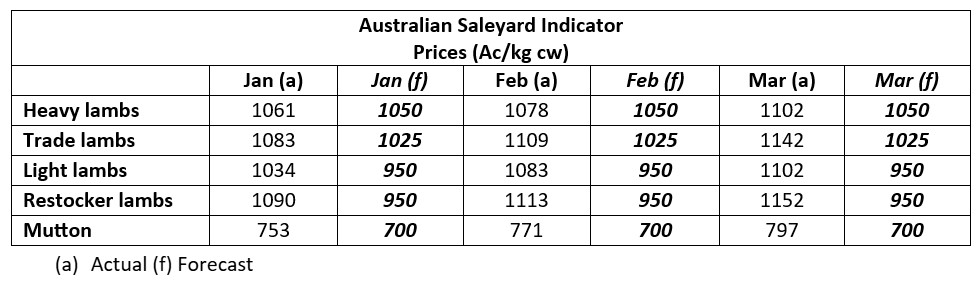 Table comparing actual vs forecast figures for Australian sheepmeat saleyard indicator price January to March 2026. Source: Meat Australian dollar Livestock Australia (MLA), Elders forecasts (f).
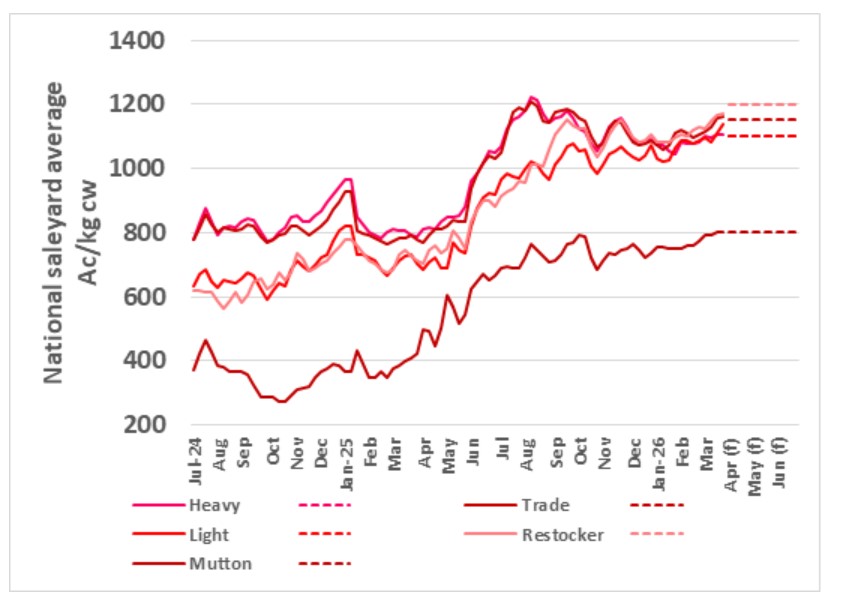 This chart shows the national saleyard indicator prices and price forecasts for major sheepmeat livestock categories in Ac/kg dressed weight. Source: Meat Australian dollar Livestock Australia (MLA), Elders forecasts (f).
Sheep and lamb slaughter will tighten further seasonally over the next few months which will underpin prices. However, demand for sheepmeat is likely to be compromised by a second round of price peaks in autumn 2026.
In response to the price and supply outlook, the local processing sector is preparing for operational adjustments. This includes reducing operating days or shifts and extending winter shutdown periods. This will restrict demand for sheepmeat and limit extent of the usual seasonal rise in sheepmeat values over the next quarter.
Restockers and feeders are likely to be prominent in markets as they look to generate cash flow by adding weight and reducing the time to market for heavy slaughter lambs to assist the industry through a period of low supply. As a result, light and store lambs will lead sheepmeat markets over the next few months for the first time in 3 to 4 years.
Supply should improve in the second half of 2026. Early scanning results have been excellent, raising hopes of a much larger lamb cohort this spring, and a lift in supply come September/October.
The mutton industry will adjust to lower supplies through autumn and winter by reducing processing capacity. The impact of restocker demand for mutton from the dramatic improvement in pasture conditions through key sheep regions has been almost immediate. Demand for mutton from producers looking to rebuild numbers will keep prices elevated at out of reach for most processors with scanned in ewes expected to push from $400 to $500 per head in coming months.
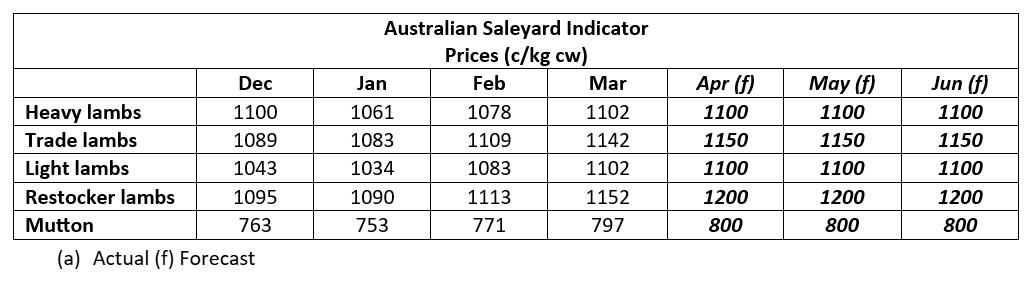 Table showing Australian sheepmeat saleyard indicator prices for the period December 2025 to June 2026. Source: Meat Australian dollar Livestock Australia (MLA), Elders forecasts.
The information contained in this article is given for the purpose of providing general information only, and while Elders has exercised reasonable care, skill and diligence in its preparation, many factors (including environmental and seasonal) can impact its accuracy and currency. Accordingly, the information should not be relied upon under any circumstances and Elders assumes no liability for any loss consequently suffered. If you would like to speak to someone for tailored advice relating to any of the matters referred to in this article, please contact Elders.