In this article Simon Quilty of Global Agri Trends unpacks the latest in global affairs and how it may affect supply of and demand for Australian sheepmeat.
To say these are turbulent times would be an understatement. War has broken out in the Middle East, tariffs imposed by America have gone up and down, China looks to impose safeguards on beef imports, and Australian sheepmeat works are considering closures.
In the last week, bombs fell all over the Middle East. All airfreights to the Middle East stopped, light lambs in Australia fell 25 ac/kg as exporters tried to grapple with a market closure.
The Middle East takes 19 per cent (pc) of Australia’s lamb exports and 27 pc of mutton exports. The lamb exports are dominated by light lamb carcase airfreight.
Mutton has a much higher dependency on the Middle East, accounting for 27 pc of all exports. Thankfully, mutton supply is falling fast, and strong global demand elsewhere will help place this product.
Tariffs remain a rollercoaster in America; the 10 pc tariff introduced at the start of 2025 was deemed illegal by the US Supreme Court for Australian lamb and other items. President Trump responded by threatening a 15 pc tariff on all imports (beef exempted), but in reality, this was not possible and is now set at 10 pc.
The shortage of both mutton and lamb is causing real angst for meat processors across Australia, with one western processor closing its doors indefinitely last week.
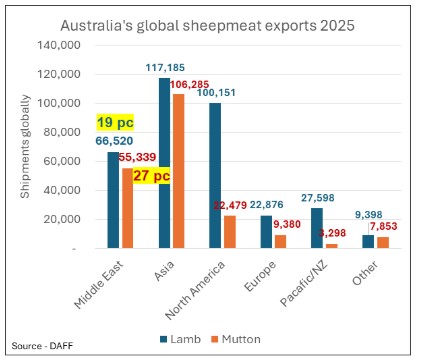 This chart shows Australia’s global sheepmeat exports in 2025. Source: Department of Agriculture, Fisheries and Forestry.
Yet, even with this said, the advice to lamb producers is to panic slowly.
Australia’s ability to diversify its meat markets is nothing new. We have done this for nearly 150 years. What is important to note is that there are options to minimise the impact of this chaos.
Recent US monthly retail data highlights that Australian lamb is positioned as a high-end product in the US retail market. The fact that lamb retails in the US at $9.07 USD/lb, compared with beef at $7.33 USD/lb, pork at $3.30, and chicken at $3.13 USD/lb, speaks volumes about how lamb belongs at the elite end of the US market.
The ‘on again, off again’ approach with various market tariffs and trade restrictions makes it difficult, but I do not believe the overall fundamentals have changed – global demand remains strong, and protein is in short supply.
Disclaimer - important, please read:
Elders provides recommendations to the best of its knowledge and based on assumptions and information which it understands to be up to date, complete and accurate. If you are aware of any error or inaccuracy with the information on which this recommendation is based, you must immediately bring this to Elders’ attention. This recommendation is provided for your use only, and not that of any other third party. In some circumstances, the information Elders provided may be in summary form or derived from information sourced from third parties, however, Elders has not independently verified the information and cannot guarantee its accuracy.
You should always carefully evaluate all available information and consult Elders or another advisor further before you commit to any course of action or rely on any recommendation. Additionally, Elders expects that you will use your knowledge, experience and best judgement in relying on any recommendation and determining whether the recommendation is, and continues to be, appropriate. Elders do not accept liability or responsibility for any indirect, consequential or economic loss or damage of any kind arising from your acceptance or reliance on this recommendation. To the fullest extent permitted by law, all guarantees, warranties or implied terms and conditions are expressly excluded and Elders’ liability with respect to any services provided is limited to re-supply of the services, or the cost of having the services re-supplied. Elders may from time to time recommend products or services for which it may receive a financial incentive (rebate, commission, benefit, etc) from a supplier/manufacturer directly related to your purchase or use of that product or service.