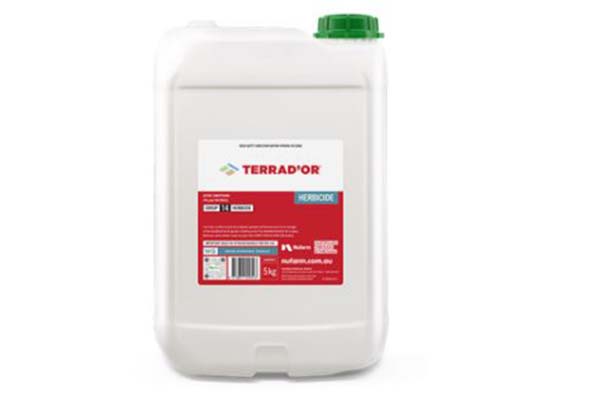
Nufarm is expanding the value of Terrad'or with a new pre-harvest registration in wheat, reinforcing its role as both a high-performing pre-seed knockdown partner and a targeted in-crop tool to reduce weed seed set.
Terrad'or has already seen strong adoption across Australia, particularly in pre-plant programs where it is commonly mixed with knockdown products such as paraquat or CRUCIAL, to improve control of hard-to-kill weeds. This new registration extends its value further into the season, giving growers another option to manage resistant and late-season weeds.
The new use pattern allows Terrad'or to be applied pre-harvest in wheat to reduce the viability of weed seeds, particularly annual ryegrass, as well as broadleaf weeds like wild radish.
Unlike other Group 14 herbicides, Terrad'or offers unique grass activity, making it especially effective on ryegrass—Australia’s most significant winter cropping weed.
Mitch Allen, commercial technical lead, said the new registration strengthens integrated weed management programs.
“Terrad'or is unique in this pre-harvest space. Unlike other Group 14s that mainly target broadleaf weeds, it gives us the ability to target key grasses such as annual ryegrass and reduce the amount of viable seed returning to the seedbank.”
Trials conducted over multiple seasons show that, when applied at the correct timing, Terrad'or can deliver around 50 per cent reduction in viable ryegrass seed set.
“We’re not talking about control, it’s about seed set reduction,” Mitch added.
“If we get our timing right, we can achieve meaningful reductions that complement other tactics like pre-emergents and harvest weed seed control.”
Effective use depends on aligning crops and weed timing:
At Z75, the grain is fully formed but still milky. This is the earliest safe application point.
David Keetch, field R&D innovation director, emphasized the balance between performance and safety.
“Getting the timing right is critical for both crop safety and maximum seed set reduction. When applied at Z75 or later, we’ve seen excellent outcomes with no yield impact while still reducing ryegrass seed viability,” he shared.
Applying too early can lead to crop injury, yield loss and residue risks, while applying too late reduces effectiveness as weed seeds continue to mature.
Trials show that when used from Z75 onwards, Terrad'or has no impact on yield or grain quality. Minor effects such as head spotting or browning may occur, but these do not translate to grain staining, yield loss or downgrades, giving growers confidence in its use.
Alongside its new wheat registration, Terrad'or remains a valuable tool in pre-seed knockdown programs, where it:
This dual use positions Terrad'or as a season-long solution, from fallow through to harvest.
As a contact herbicide, coverage is critical. Recommended application practices include:
“Maximizing coverage is key to getting the most out of Terrad'or,” Mitch said.
Terrad'or is designed to work alongside existing strategies, not replace them. Integrated with pre-emergents, knockdowns and harvest weed seed control, it provides a valuable additional lever.
As Mitch summarized, “It’s not a standalone solution, but it’s a very useful tool. If we line up crop and weed timing, it can make a real difference in reducing the seedbank for future seasons.”
With expanded use in wheat and continued strength in knockdown programs, Terrad'or offers growers greater flexibility to protect current crops while reducing future weed pressure.
This article was written by Nufarm for Seasons.
Disclaimer - important, please read:
Elders provides recommendations to the best of its knowledge and based on assumptions and information which it understands to be up to date, complete and accurate. If you are aware of any error or inaccuracy with the information on which this recommendation is based, you must immediately bring this to Elders’ attention. This recommendation is provided for your use only, and not that of any other third party. In some circumstances, the information Elders provided may be in summary form or derived from information sourced from third parties, however, Elders has not independently verified the information and cannot guarantee its accuracy.
You should always carefully evaluate all available information and consult Elders or another advisor further before you commit to any course of action or rely on any recommendation. Additionally, Elders expects that you will use your knowledge, experience and best judgement in relying on any recommendation and determining whether the recommendation is, and continues to be, appropriate. Elders do not accept liability or responsibility for any indirect, consequential or economic loss or damage of any kind arising from your acceptance or reliance on this recommendation. To the fullest extent permitted by law, all guarantees, warranties or implied terms and conditions are expressly excluded and Elders’ liability with respect to any services provided is limited to re-supply of the services, or the cost of having the services re-supplied. Elders may from time to time recommend products or services for which it may receive a financial incentive (rebate, commission, benefit, etc) from a supplier/manufacturer directly related to your purchase or use of that product or service.