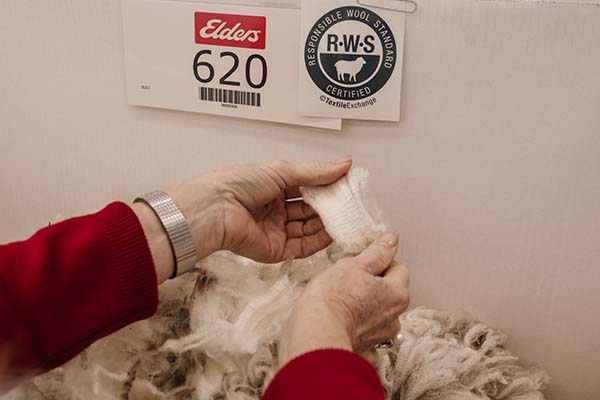
Independent Commodity Services analyst Andrew Woods looks at trends in Responsible Wool Standard (RWS) volume and premiums across Australian and South African wool markets.
Key points:
A bright spot in the greasy wool market during recent years has been premiums paid for RWS accredited wool, although these premiums have waxed, then waned and waxed again. This article takes a look at Merino premiums for RWS since 2021.
The RWS, developed by the Textile Exchange, has been around for a while. RWS is changing to the Materials Matter Standard at the end of 2026. It was in late 2021, after Cape Wools began publishing weekly premiums for RWS that premiums took off in the Australian greasy wool market. Premiums at the time, in 2022, were being paid on wool that was accredited to RWS regardless of quality. This is one aspect of RWS which sometimes is missed. It is an animal welfare standard, not a wool quality standard.
While the Textile Exchange publishes annual market share statistics for RWS by country, this data is usually 12 to 18 months old and is a gross proportion for each country, so it does not tell us much about the supply by breed and within breed by quality. The graph opposite shows month auction volumes for RWS accredited Merino wool sold in Australia, South Africa (worked back to Australian bale weights which are heavier than in South Africa) and New Zealand wool sold in Melbourne, from September 2021 onwards.
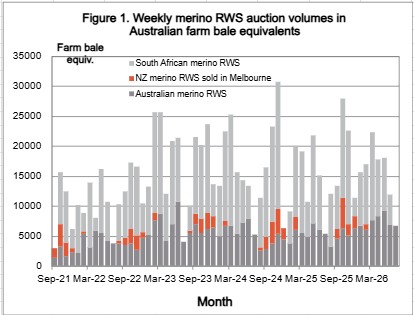 Graph showing weekly Merino RWS auction volumes in Australian farm bale equivalent. Source: Independent Commodity Services.
Volumes increased from 2021 through to early 2023. Since then, there has been no real noticeable trend (up or down) in RWS Merino volumes sold at auction. RWS wool is sold outside of auction in the three countries, and also in South America where there is no centralised sale system, so volumes may have increased where we cannot see.
What is clear is that premiums have varied widely during the past five years. The graph opposite shows the published Cape Wools premiums for 19 micron fleece and an estimate for 19 micron fleece premiums sold in Australia, from September 2021 onwards. The boom period in late 2021 through 2022 was followed by small premiums in 2023 into 2024. The Textile Exchange market share data shows a fall in market share at the time presumably in response to the low premiums.
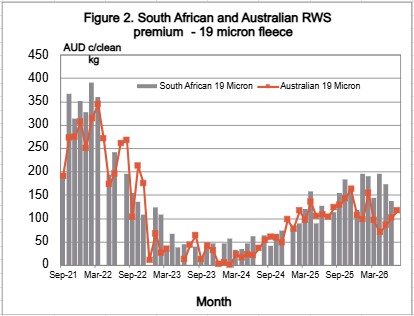 Graph showing South African and Australian RWS premium -19 micron fleece. Source: Independent Commodity Services.
Since mid-2024 the premiums have recovered, spending a lot of time in the AUD 100 to 150 cents (clean) range during the past 18 months. Premiums for crossbred wool also picked up during this time, and were substantial in relation to the underlying wool price.
The question now, is what will the premiums do? As the first graph shows, the supply is relatively steady (albeit volatile month to month). RWS accreditation has a cost, so premiums have to be high enough to compensate for the cost and presumably have to be somewhat higher still to entice more (new) supply.
Monitoring of premiums paid for RWS is required, simply to ensure costs incurred in meeting the standard are recovered when the wool is sold. This is something that AWEX, as the wool market reporting institution in Australia should consider. For some specialty (very fine) types of wool RWS accreditation provides access to higher price levels, although some in the industry see the Textile Exchange as getting between them and their customers. For many Australian farmers, mulesing remains a major block to accreditation, something the other Merino regions in the southern hemisphere do not have to worry about hence half of the South African Merino clip being accredited.
Disclaimer - important, please read:
Elders provides recommendations to the best of its knowledge and based on assumptions and information which it understands to be up to date, complete and accurate. If you are aware of any error or inaccuracy with the information on which this recommendation is based, you must immediately bring this to Elders’ attention. This recommendation is provided for your use only, and not that of any other third party. In some circumstances, the information Elders provided may be in summary form or derived from information sourced from third parties, however, Elders has not independently verified the information and cannot guarantee its accuracy.
You should always carefully evaluate all available information and consult Elders or another advisor further before you commit to any course of action or rely on any recommendation. Additionally, Elders expects that you will use your knowledge, experience and best judgement in relying on any recommendation and determining whether the recommendation is, and continues to be, appropriate. Elders do not accept liability or responsibility for any indirect, consequential or economic loss or damage of any kind arising from your acceptance or reliance on this recommendation. To the fullest extent permitted by law, all guarantees, warranties or implied terms and conditions are expressly excluded and Elders’ liability with respect to any services provided is limited to re-supply of the services, or the cost of having the services re-supplied. Elders may from time to time recommend products or services for which it may receive a financial incentive (rebate, commission, benefit, etc) from a supplier/manufacturer directly related to your purchase or use of that product or service.