
High mouse populations remain a significant challenge for growers in certain regions of Australia who are heading into winter cropping. With the right preparation and monitoring, the risk to establishing crops can be significantly reduced.
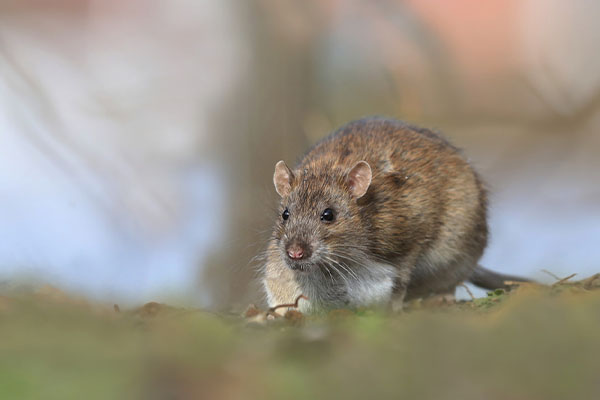 Image of mouse scurrying across a field courtesy of BASF.
Going into winter crops, check all stubble paddocks regularly. Counting active burrows along a 100 metre transect is a reliable method of estimating mouse numbers. This should be done in several locations across each paddock and across all paddocks scheduled for planting.
Based in Northampton, Elders agronomist Belinda Eastough said mice numbers in her area are currently higher than seen during plagues of previous years.
“Mice numbers are higher than we previously saw in the 2021 and 2022 plagues in the Northampton area,” Belinda said
“We are currently counting an average of 30 holes per 100 m², which equates to approximately 6,000 mice per hectare in paddocks with more than 100 kg/ha of grain on the ground.
"At present mouse cards are not an effective way to determine population numbers in our area, due to high levels of background food.
"Active burrows are currently a more accurate way of determining population levels in the Northampton to Yuna area.”
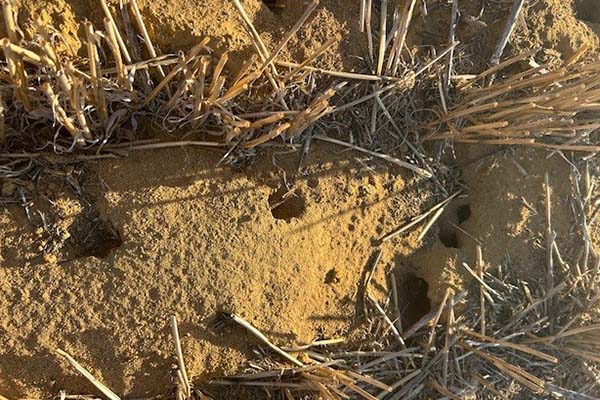 Evidence of burrows in cereal stubble at Yuna, Western Australia.
Growers are also encouraged to use the MouseAlert website to report sightings and help keep local data up to date.
Mouse populations build rapidly when large food sources are available, particularly after strong cereal seasons. Grain remaining in fallowed paddocks continues to provide both food and shelter.
The good news is that high mouse numbers will also drive competition for those resources. As food sources are reduced, control measures become more effective. Spraying out germinations and grazing fallow paddocks with sheep (where possible) can continue to deplete available food, helping ensure baiting is most effective at planting.
Broadscale zinc phosphide* treated grain remains an effective baiting option when applied at the label rate of 1 kilogram per hectare. While this may seem minimal, it equates to approximately 1.5 lethal doses per square metre.
Timing is critical. Applying bait immediately after planting can significantly reduce crop seed damage. Ideally, bait should be spread behind the planter so residual food sources are covered and bait remains easily accessible to mice. Where this isn’t possible, baiting within 24 hours of planting will still help reduce risk from high mouse populations. Always read and follow the directions on products.
Active monitoring and early management will give winter crops the best chance to emerge and establish successfully, even under high mouse pressure.
*Always read and follow product advice and directions.
Disclaimer - important, please read:
Elders provides recommendations to the best of its knowledge and based on assumptions and information which it understands to be up to date, complete and accurate. If you are aware of any error or inaccuracy with the information on which this recommendation is based, you must immediately bring this to Elders’ attention. This recommendation is provided for your use only, and not that of any other third party. In some circumstances, the information Elders provided may be in summary form or derived from information sourced from third parties, however, Elders has not independently verified the information and cannot guarantee its accuracy.
You should always carefully evaluate all available information and consult Elders or another advisor further before you commit to any course of action or rely on any recommendation. Additionally, Elders expects that you will use your knowledge, experience and best judgement in relying on any recommendation and determining whether the recommendation is, and continues to be, appropriate. Elders do not accept liability or responsibility for any indirect, consequential or economic loss or damage of any kind arising from your acceptance or reliance on this recommendation. To the fullest extent permitted by law, all guarantees, warranties or implied terms and conditions are expressly excluded and Elders’ liability with respect to any services provided is limited to re-supply of the services, or the cost of having the services re-supplied. Elders may from time to time recommend products or services for which it may receive a financial incentive (rebate, commission, benefit, etc) from a supplier/manufacturer directly related to your purchase or use of that product or service.