Elders Business Intelligence Analyst Richard Koch discusses his data driven forecast for the Australian cattle market this spring and the factors affecting it.
The winter 2026 quarter has been characterised by unseasonally strong restocker demand against a backdrop of toughening beef export market conditions. Despite falling export market returns and compressed feeding and processing margins, cattle prices held above expectations. However, towards the backend of the quarter, prices began to trend lower as grazier demand eased.
Restockers were very active in the early part of the quarter encouraged by phenomenal winter pasture production as regular rain and mild temperatures brought Spring conditions early to south-eastern Australia. Graziers competed against feeders and processors to push local cattle prices higher and squeeze margins as beef export returns contracted.
The impact of strong grazier demand through the winter quarter was evident on the prices paid for feeder and store cattle that traded at an historically wide premium of 70 to 90c/kg liveweight (lw) above heavy slaughter steers vs the long-term average of 30 to 40c/kg lw. This saw prices for these categories outperform our forecasts by 40 to 60c/kg through the forecast period.
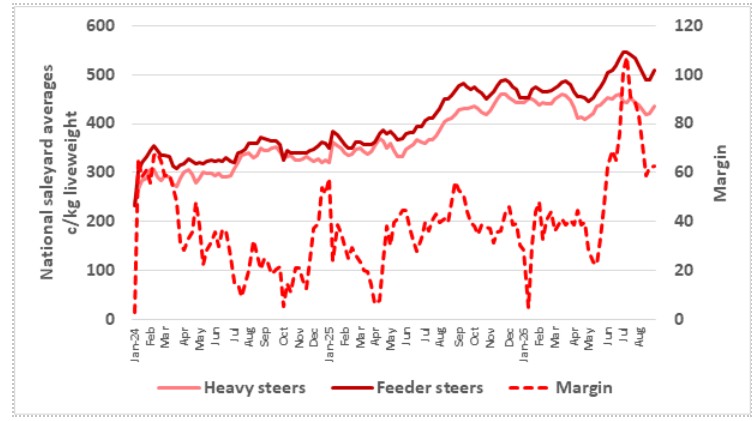 This chart shows the national saleyard average prices for heavy and feeder steers and the margin between the two. Source: MLA.
Restocker cattle values eased sharply in August to below feeder cattle prices, with heifer values particularly affected as seasonal uncertainty begins to increase with forecasts that a strong El Nino will influence weather patterns through spring and into the end of 2026.
Feeder cattle values have been assisted by the ongoing expansion of feedlot capacity in NSW and Queensland which has increased demand for feeder cattle. Feedlot capacity reached a record high, totalling just below 1.8 million head in the June 2026 quarter. This is up around 90,000 head from June 2025 (at 1.5 turns/per year equates to a requirement for 135,000 additional feeder steers). This and buying to place cattle on feed for the reopening of north Asian beef quotas in early 2027 assisted feeder cattle values which rose despite the 100-day grainfed beef contract barley nudging higher. Queensland flatback steer values rose from 450c/kg lw at the end of autumn to peak at 550c/kg lw, while the forward contract rose from 850 to 900c/kg dressed weight, indicating feeders swallowed losses to keep pens full during winter. Southern feeder cattle spreads widened seasonally to +$1/kg lw above flatbacks during the quarter but have begun to tighten again as supplies of these cattle of crops increase and as Queensland feeder supplies tighten.
In contrast to 2025, where strong beef demand assisted a rise in cattle values, beef demand in 2026 has been affected by high relative beef prices and mounting cost of living pressures. Despite US production being 5 per cent (pc) below last year, processors have been unable to push beef prices above year ago levels, indicating beef demand has eased.
Weakening US beef demand combined with Asian beef import market restrictions and a likely increase in competition from displaced Brazilian beef has created a very different backdrop for Australian beef export returns in 2026.
The 90CL US beef export price has eased through much of this year. After peaking at just shy of 1200Ac/kg in January - it averaged 1030Ac/kg in August, having eased a further 8 per cent during the winter quarter, squeezing beef export processing margins.
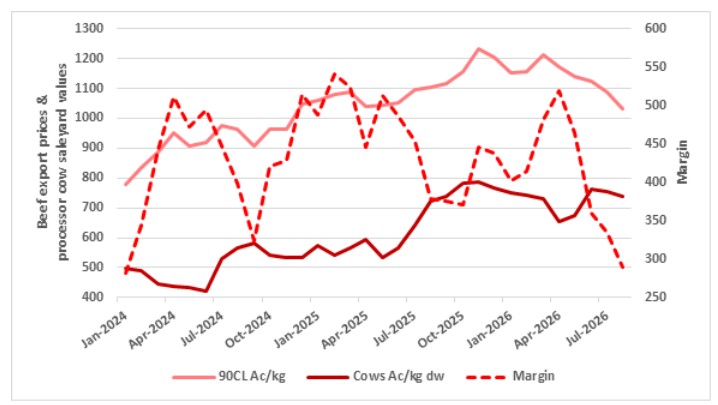 This chart shows 90CL beef export prices vs the national saleyard average and the margin between the two. Source: MLA.
Despite compressed processing margins, tight supplies of suitable slaughter cattle across southern Australia has seen southern processors compete for stock and support cattle values in northern markets at 20 to 30c/kg lw levels above those forecast through the winter quarter. Over the hooks prices for slaughter cattle categories eased around 20c/kg lw during the quarter in line with weaker export market returns.
The table below shows the actual (a) and forecast (f) MLA national saleyard averages by category. Source: Meat and Livestock Australia (MLA) and Elders forecasts.
| June (a) | June (f) | July (a) | July (f) | Aug (a) | Aug (f) | |
|---|---|---|---|---|---|---|
| Heavy steer | 456 | 440 | 443 | 420 | 430 | 410 |
| Processor cows | 381 | 380 | 377 | 360 | 370 | 340 |
| Feeder steer | 523 | 470 | 536 | 460 | 505 | 450 |
| Feeder heifers | 478 | 420 | 490 | 400 | 464 | 400 |
| Restocker steer | 534 | 500 | 537 | 480 | 494 | 470 |
| Restocker heifers | 458 | 430 | 452 | 410 | 406 | 400 |
After spending much of the winter quarter defying trends in beef export returns, Australian cattle values should ease moderately in spring in-line with a weaker beef export market outlook and a seasonal pick up in cattle supplies across the south.
As local supply lifts seasonally, markets will focus on beef export demand where Australian exporters face an increasingly difficult export environment owing to unfavourable shifts in the export environment.
In the past quarter, Australia has triggered its safeguard quotas for China and Korea which has seen a sharp reduction in exports to these markets. Under quota in May, Australia was shipping around 57,000 tonnes combined to these markets. This is set to fall to around 20,000 tonnes in August and will fall further again as Australian exporters face an out-of-quota tariff disadvantage compared to other exporters.
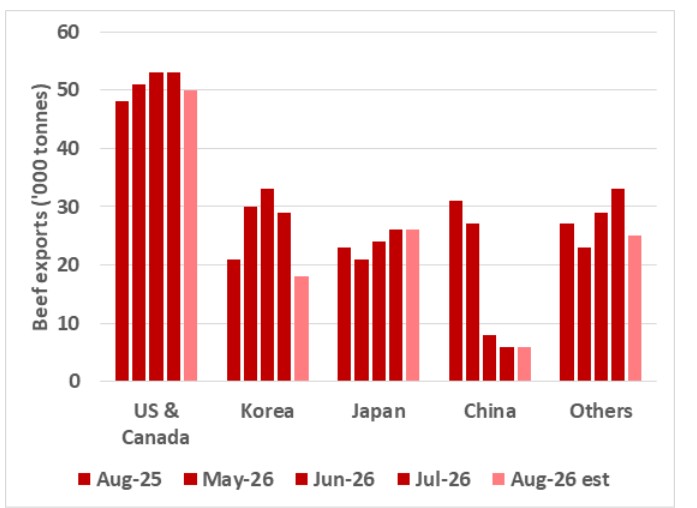 This chart shows Australian monthly beef exports to major destinations. Source: DAFF.
Secondly, Australian exporters will face increased competition from Brazil as its export market access is restricted. Over the next week Brazil will fill its China quota while the European Commission has completely removed Brazil from the list of countries eligible to ship beef to the EU due to non-compliance. In July, Brazil shipped 140,000 tonnes to Brazil, while it exports around 130,000 tonnes annually to the EU.
Brazilian exporters will likely redirect displaced exports to the US under a deal recently announced by Trump to allow an additional 300,000 tonnes of beef into the US over the next 90 days in a bid to lower retail beef prices. According to a Presidential proclamation, tariff free imports will be restricted to 100,000 tonnes per month and apply only to beef trimmings. While this volume represents just over 2 pc of total consumption and 11 pc of annual import volumes, it is around 50 pc of quarterly imports.
The out of quota tariff waiver will clearly benefit countries that currently have filled their quota and are paying the higher tariff. Australian suppliers will lose their 26.4 pc tariff advantage with South American (most likely Brazilian) exporters able to offer larger discounts to secure orders.
The other major development to note from the US is the sudden announcement that Tyson will close its Joslin, IL beef plant (roughly 3,000 head of daily slaughter capacity) and its Eagle Mountain boning facility. It will also offer its Pasco, WA plant (about 2,000 head daily) for sale. Combined with the Lexington, NE closure (about 5,000 head daily) and JBS’s Souderton, PA closure (about 2,000 head daily), the US industry has clearly started to remove excess processor capacity.
This is not too surprising as the US packing sector was built decades ago during a period of higher cattle inventories. Too much processing capacity chasing too few cattle produces sustained packer losses and capacity is adjusting. For the past 3 years, US processors have been consistently losing around $200/head, suggesting US cattle are around 25 to 50c/lb overpriced. Weaker processor demand will gradually bring US cattle prices back in line with global cattle values.
The USDA’s August Cattle on Feed report pegged the 1 August US feedlot inventory at 11.1 million head, 2 pc above a year ago. More striking were July placements of 1.42 million head (down 11 per cent from 2025 and lowest on record) and July marketings of 1.62 million head (down 7 per cent). To alleviate tight US cattle supplies, the USDA has moved to lift the ban on Mexican cattle imports (due to Mexican screwworm) by opening a quarantine point in Douglas, Arizona. The USDA plans to open two more New Mexico ports, one in 30 days and another in 60 days.
Unfavourable trade developments, flagging export beef demand and tightening processing margins will likely contribute to a moderate easing in cattle prices through the spring quarter. Cow and manufacturing cattle values are likely to be the worst affected by trade access developments as Brazilian exporters significantly ramp up exports to the US in direct competition to Australian cow beef.
Buying for the opening of China and Korea will resume in October and provide the catalyst for a recovery in prices which should continue into late 2026 and the early part of 2027.
North Asian safeguard restrictions will increasingly distort export demand for Australian beef and concentrate peak demand for Australian export slaughter cattle in the period from November through to April.
This in turn will likely concentrate demand for feeders suitable to these markets in the June to October period (assuming the spend 150 days on feed). Feedlot buying to support the new peak demand period in late 2026 and early 2027 will support feeder values through spring. These cattle are likely to continue to trade at an historically wide premium to heavy slaughter cattle through this period. Tightening supplies of northern feeders should reduce the flatback feeder steer discount to southern feeders through the Spring quarter. However, higher grain prices (+$400/t Downs) in part due to problems in shipping grain out of the Black Sea, will constrain feeder margins and limit the amount the feedlots will pay for feeder cattle at levels below the winter quarter.
Restocker demand and prices for these cattle will remain dependent on seasonal conditions. With the season ending in Queensland and conditions tightening in northern NSW, coupled with forecasts for a strong El Nino and toughening export market conditions, it is likely that grazier demand for cattle will ease into late 2026.
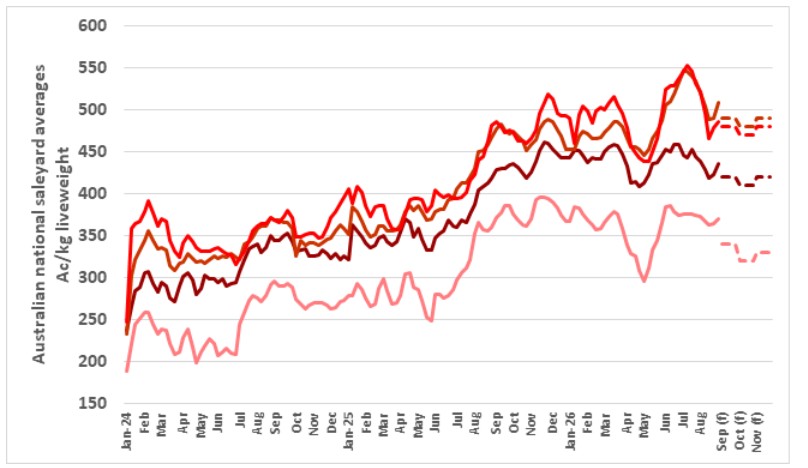 This chart shows national saleyard indicator prices and Elders price forecasts for major cattle categories. Source: Meat and Livestock Australia (MLA) & Elders forecasts (f).
The table below shows the Australian Saleyard Indicator Prices (Ac/kg lw), both actual (a) and forecast (f). Source: Source: Meat and Livestock Australia (MLA) & Elders forecasts and projections.
| May | June | July | Aug | Sept(f) | Oct (f) | Nov (f) | |
|---|---|---|---|---|---|---|---|
| Heavy steer | 435 | 456 | 443 | 430 | 420 | 410 | 420 |
| Processor cows | 337 | 381 | 377 | 370 | 340 | 320 | 330 |
| Feeder steer | 471 | 523 | 536 | 505 | 490 | 480 | 490 |
| Feeder heifers | 424 | 478 | 490 | 464 | 440 | 430 | 440 |
| Restocker steer | 466 | 534 | 537 | 494 | 480 | 470 | 480 |
| Restocker heifers | 372 | 458 | 452 | 406 | 410 | 400 | 410 |
Disclaimer - important, please read:
Elders provides recommendations to the best of its knowledge and based on assumptions and information which it understands to be up to date, complete and accurate. If you are aware of any error or inaccuracy with the information on which this recommendation is based, you must immediately bring this to Elders’ attention. This recommendation is provided for your use only, and not that of any other third party. In some circumstances, the information Elders provided may be in summary form or derived from information sourced from third parties, however, Elders has not independently verified the information and cannot guarantee its accuracy.
You should always carefully evaluate all available information and consult Elders or another advisor further before you commit to any course of action or rely on any recommendation. Additionally, Elders expects that you will use your knowledge, experience and best judgement in relying on any recommendation and determining whether the recommendation is, and continues to be, appropriate. Elders do not accept liability or responsibility for any indirect, consequential or economic loss or damage of any kind arising from your acceptance or reliance on this recommendation. To the fullest extent permitted by law, all guarantees, warranties or implied terms and conditions are expressly excluded and Elders’ liability with respect to any services provided is limited to re-supply of the services, or the cost of having the services re-supplied. Elders may from time to time recommend products or services for which it may receive a financial incentive (rebate, commission, benefit, etc) from a supplier/manufacturer directly related to your purchase or use of that product or service.