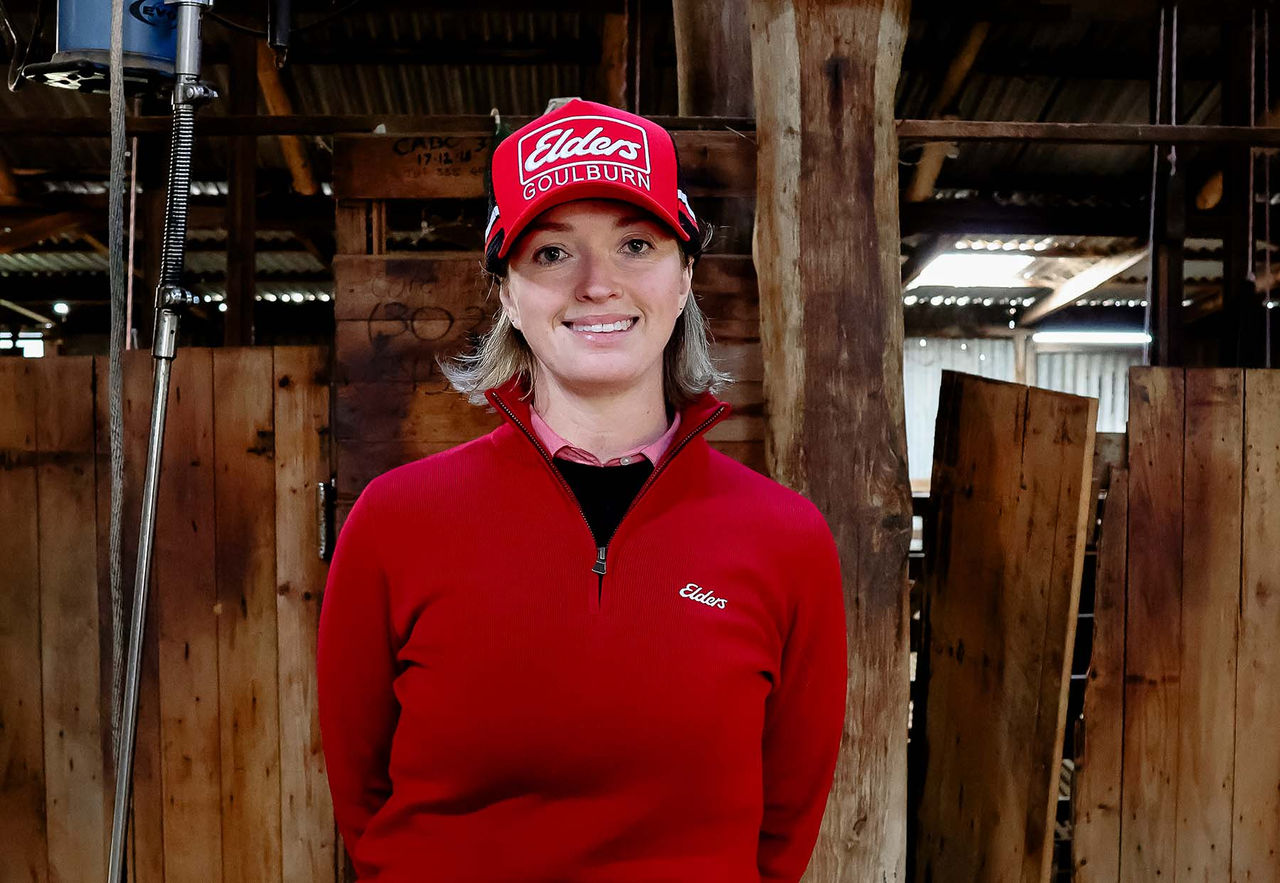
Elders Rural Products Specialist Tess Geaghan provides her advice for ensuring livestock receive balanced calcium and phosphorus nutrition.

Achieving optimum nutrition can often feel like chasing a moving target, managing unique requirements of different classes of stock or stage of production, while predicting potentially rapid changes to pasture conditions. Furthermore, you are subject to volatile prices and scarcity in the supplementary feed market if you don't have surplus on farm. When you find yourself behind in terms of feed, the temptation to throw a few bales of unknown quality hay or empty the last silo can be hard to resist. Same goes for quickly purchasing untested feed from the first available vendor.
Around the country our Elders team has been seeing some alarming feed test results. It's not the usual suspects (protein, metabolisable energy, neutral detergent fibre) that have our attention.
We are seeing some concerning Calcium (Ca) and Phosphorus (P) levels.
We normally expect to see adequate Ca in forage, particularly when legumes are included. Typically concentrates are lower in Ca. Some analysis has indicated Ca levels far below expected based on the feed type. These results serve as a good reminder to never assume you know the nutrient profile of a feed.
In practical terms, they are essential for proper physiological function, including bone development, muscle, immune and nervous system function. Ca especially is required in huge amounts in young growing cattle and sheep, who are expected to lay down bone and muscle at a rapid rate. Lactating mothers too, require higher than normal Ca intake with inadequate dietary Ca leading to milk fever or grass tetany.
Where it gets complex is the interaction of the two minerals within the body. They are associated by homeostatic mechanisms, meaning that the concentration of each in the bloodstream is linked. This impacts absorption from dietary sources as well as the deposition and release of mineral from the bone.
We are mostly concerned with the ability of P to interfere with the absorption of Ca. This means we must consider them together when analysing a ration. Mineral nutrition is never going to be a perfect science, but if you aim for a Ca:P ratio of 2:1 it should keep you in good stead. Most importantly, do not let P exceed Ca or you risk compromising the bone health of your stock.
We recommend assessing the P requirements of your stock based on animal class, size and stage of production, ensuring it is adequate in feed, and augmenting the calcium level around this. Luckily, Ca imbalances here can be reasonably easy to correct.
For the price of a feed test you can rest assured that you are not compromising Ca absorption and therefore bone health and future integrity of your stock. If the results of your feed test are otherwise sound, a few simple and cost-effective additions can correct this imbalance and help you sleep at night.
Disclaimer - important, please read:
Elders provides recommendations to the best of its knowledge and based on assumptions and information which it understands to be up to date, complete and accurate. If you are aware of any error or inaccuracy with the information on which this recommendation is based, you must immediately bring this to Elders’ attention. This recommendation is provided for your use only, and not that of any other third party. In some circumstances, the information Elders provided may be in summary form or derived from information sourced from third parties, however, Elders has not independently verified the information and cannot guarantee its accuracy.
You should always carefully evaluate all available information and consult Elders or another advisor further before you commit to any course of action or rely on any recommendation. Additionally, Elders expects that you will use your knowledge, experience and best judgement in relying on any recommendation and determining whether the recommendation is, and continues to be, appropriate. Elders do not accept liability or responsibility for any indirect, consequential or economic loss or damage of any kind arising from your acceptance or reliance on this recommendation. To the fullest extent permitted by law, all guarantees, warranties or implied terms and conditions are expressly excluded and Elders’ liability with respect to any services provided is limited to re-supply of the services, or the cost of having the services re-supplied. Elders may from time to time recommend products or services for which it may receive a financial incentive (rebate, commission, benefit, etc) from a supplier/manufacturer directly related to your purchase or use of that product or service.