Independent Livestock Analyst, Simon Quilty of Global Agri Trends shares his thoughts on movements in Australia’s sheep sector.
Last week's Australian Bureau of Statistics (ABS) data revealed that mutton slaughter reached the breakeven point for liquidation and rebuilding at 2 million head. Given the momentum of tight supply in lamb and mutton, not easing in the weekly data, it would be a fair assumption that the rebuild has commenced in Q4, the quarter we are in.
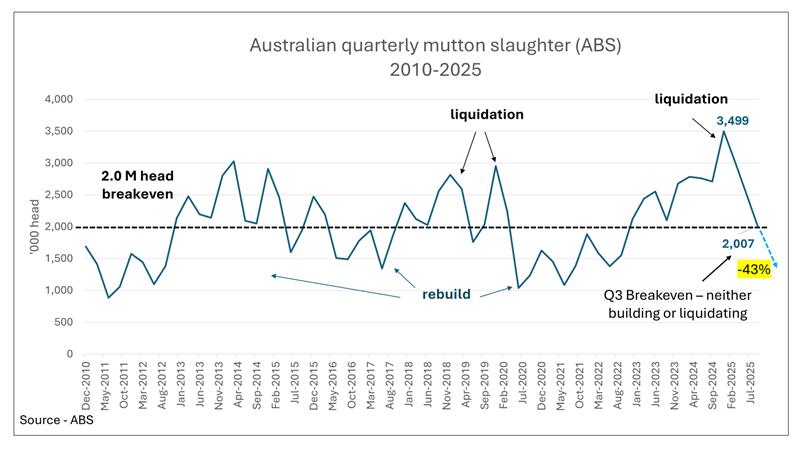 This chart shows Australian quarterly mutton slaughter from 2010 to 2025. Source: ABS
Both lamb and mutton slaughter have fallen off a cliff, down 27 per cent (pc) and 43 pc, respectively, and with lighter carcass weights, production has fallen even further.
None of this is a surprise, given the dryness of southern Australia over the last two years and the heavy turnoffs we have seen. My forecast for July/August next year of 1350 ac/kg CWE for heavy lambs and trade lambs is still on track.
How sustainable is this? It's important to note that much of today's higher livestock pricing is due to strong demand, and the further higher prices moving forward will be more due to tighter supplies, the hallmarks of a rebuild.
But, as with any rebuilding period, prices rise 30 pc and fall 30 pc. These prices are ultimately unsustainable, as livestock numbers will build over three years, leading to lower prices.
I believe the long-term price trade/heavy lambs will settle at 950 ac/kg CWE in 2028 to 2033. I call this the new norm, and it is sustainable for producers and processors.
Last week's ABS data supports this view of stronger lamb and mutton prices over the next three years until prices fall back to the new norm, ensuring a sustainable future.
Disclaimer - important, please read:
Elders provides recommendations to the best of its knowledge and based on assumptions and information which it understands to be up to date, complete and accurate. If you are aware of any error or inaccuracy with the information on which this recommendation is based, you must immediately bring this to Elders’ attention. This recommendation is provided for your use only, and not that of any other third party. In some circumstances, the information Elders provided may be in summary form or derived from information sourced from third parties, however, Elders has not independently verified the information and cannot guarantee its accuracy.
You should always carefully evaluate all available information and consult Elders or another advisor further before you commit to any course of action or rely on any recommendation. Additionally, Elders expects that you will use your knowledge, experience and best judgement in relying on any recommendation and determining whether the recommendation is, and continues to be, appropriate. Elders do not accept liability or responsibility for any indirect, consequential or economic loss or damage of any kind arising from your acceptance or reliance on this recommendation. To the fullest extent permitted by law, all guarantees, warranties or implied terms and conditions are expressly excluded and Elders’ liability with respect to any services provided is limited to re-supply of the services, or the cost of having the services re-supplied. Elders may from time to time recommend products or services for which it may receive a financial incentive (rebate, commission, benefit, etc) from a supplier/manufacturer directly related to your purchase or use of that product or service.