Curnamona Station has marked a century of continuous family ownership, built on steady progress, resilience and a partnership that has stood the test of time.
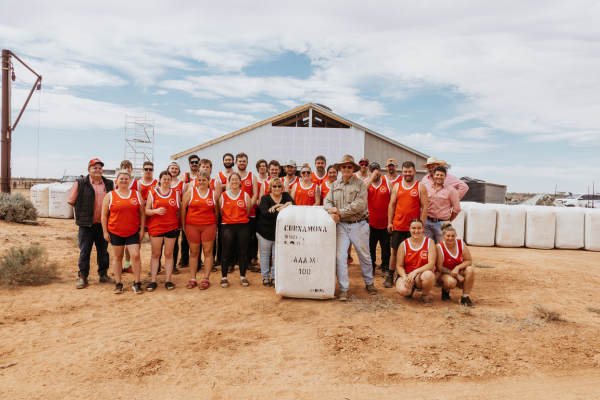
When Bruce Nutt’s great-grandfather purchased the property, about 110 kilometres north of Yunta in South Australia’s northeast pastoral district, in 1925, he turned to Elders for support to make it happen. That moment marked the beginning of a relationship that has endured ever since.
“In 100 years, I doubt whether any product or produce from Curnamona has ever gone anywhere but through Elders,” Bruce said.
“We’re really just repaying the debt. My great-grandfather went to Elders for support, and it’s been part of our story ever since.”
Elders had been part of Australia’s rural landscape since 1839, supporting stations like Curnamona through decades of change.
Built in 1919 by the Canowie Pastoral Company, Curnamona’s 16-stand woolshed remains at the heart of station life more than a century later.
“It had two boards, eight shearers on each side, all run by a belt drive - quite an operation in its day,” Bruce said.
More than 100 years on, the shed is still in full use.
“We’ll shear about 18,000 this year,” Bruce said.
“There’s more cattle now, but it’s still a significant shed.”
A major turning point for Curnamona came in 1987.
“I sat down with our long-time station manager, Ron Morehouse, and asked what the most important thing was,” Bruce said.
“He said, ‘We’ve never run out of feed - it’s water that’s the issue.’ From that day on, we started a development program, and now the property’s gone from one of the worst-watered places in the northeast to one of the best.”
That conversation set the direction for the decades to follow. With better access to water, Bruce says the land and the business are now far more resilient. It’s the result of years of steady improvement, a theme that runs through his whole approach to managing Curnamona.
“In this environment, what some call drought is just the norm. It’s about having a diverse business, managing risk, and leaving something for the next generation.”
Detailed station records going back to the early days show a consistent story.
“When I compare our records from 1925 to today, not much has changed,” Bruce said.
“That tells me we’ve probably got the sustainability about right.”
Bruce has been part of the wool industry all his life and has seen the full sweep of change, from the old wool stores at Port Adelaide to the high-tech Elders Wool facility in Melbourne today.
“I remember going to the wool stores at Port Adelaide with my father, watching the unloading of trucks. There’d be blokes with trolleys and hooks over their shoulders, taking a bale each and wheeling them off,” he said.
“Then you go to Ravenhall now, and the advances are extraordinary. It’s all about efficiency - that’s just the way the world is.”
For Bruce, though, the constant through all that change has been family.
“At the end of the day, in a business like this, you’re just looking after it for someone else - for the next generation to carry on with the same passion,” he said.
“It’s a nice legacy. You just keep at it, that’s what it’s about.”