
As a second-year participant in Elders’ Graduate Agronomy Program, Jack Watson’s hands-on approach is helping to assess an emerging problem for farmers: glyphosate-resistant ryegrass.
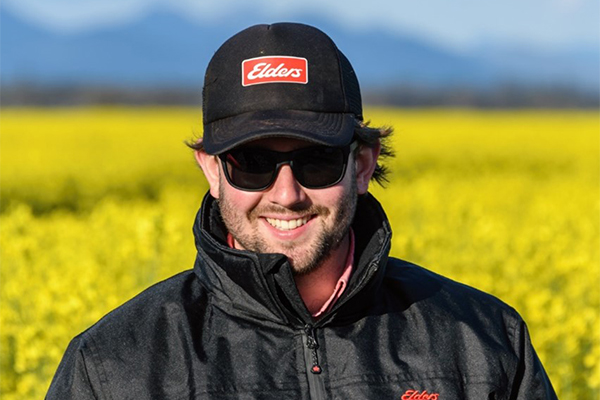 Jack Watson, Elders Graduate Agronomist based in Northam WA.
Currently based in Northam, Jack has had the chance to work across some of the most diverse regions of Western Australia.
Growing up on a family farm in Mukinbudin, it was only natural for Jack to find his way into agronomy. Since joining Elders, he’s been learning the ropes and gaining valuable experience.
“It’s amazing how quickly the landscape can change,” Jack said.
“One day, you’re knee-deep in water in a flooded Albany pasture, talking agronomy in the rain. The next, you’re out in East Binnu, where crops are thriving thanks to deep sowing into the tiniest bit of summer moisture. That’s what makes this work so interesting.”
One of Jack’s key projects this year is investigating glyphosate-resistant ryegrass, an emerging issue for Australian growers. In July, he led a resistant ryegrass knockdown demonstration in Mukinbudin, where lab tests had confirmed the presence of glyphosate resistant ryegrass. The goal was to find alternative solutions as glyphosate becomes less effective in some areas.
The trial tested 25 different treatments across small three-by-three metre plots. Jack and his team closely monitored how each combination worked on ryegrass at different stages of growth.
“Higher level of ryegrass control was given using selective grass herbicides and non-selective glyphosate” Jack said.
“By following it up with another alternative, we were able to get better control and reduce the spread of resistant plants. It’s not perfect, but it’s a good start.”
For Jack, this trial is about more than just managing weeds, it’s about giving farmers the tools they need to stay ahead of these challenges, which if left untreated, can have significant impacts on a farm’s profitability.
“Managing ryegrass early is really important,” he said.
“If you don’t tackle it from the start, you’ll end up needing repeated applications, which is costly and unsustainable.”
Through the graduate program, which enables graduate agronomists to build skills and capacity over time, Jack has had the chance to connect with farmers and agronomists at a grassroots level . The trial site is playing a big role in educating both growers and agronomists.
“Our trial sites give us the chance to show farmers the appropriate weed management strategies,” Jack said.
“It’s one thing to discuss solutions, but when farmers see approaches like the double-knock in action, it builds confidence. Trials and demonstrations help us tackle field challenges like resistance and regulation together.”
Disclaimer: These trial and demonstration results are for demonstration/informative purposes only, and do not constitute advice nor are they a guarantee as to specific results or outcomes that may, or could, be achieved. Any techniques or the like used during or in the trial and demonstration should only be used by experienced growers following proper consideration of a variety of factors including, but not limited to, suitability. Any grower should obtained their/its own tailored advice that should have regard to the specific circumstances of the relevant paddock or property and environmental conditions. Elders accepts no responsibility for use of trial/demonstration material inconsistent with this disclaimer.