
Elders Ltd (ASX: ELD) confirms that CC Cooper and Co and Consolidated Pastoral Company (CPC) have entered into a sale and purchase agreement in relation to Madura Plains Station.
The agreement is conditional upon CPC receiving the customary Western Australia government approval to the transfer of the pastoral leases. The sale is otherwise unconditional and has received FIRB approval.
Madura Plains has been sold on a going concern “walk in walk” out basis, including the sheep flock and goat herd. All current employees will be offered ongoing roles with CPC.
No sale price will be disclosed.
Madura Plains is an aggregation of two pastoral leases (Madura and Moonera) with a combined area of 711,638 hectares (1,758,496 acres) and a carrying capacity in excess of 60,000 sheep.
Located near the border of Western Australia and South Australia, Madura Plains is strategically positioned to participate in both the western and eastern sheep and wool markets.
The Madura lease was taken up in 1876 by G. Heinzmann to establish a station for breeding cavalry horses designed for the British Imperial Indian Army. It was selected due to the reliable underground bore water and an abundance of available feed. It also played an important role during WWII when the station’s bore was crucial to army engineers constructing the Eyre Highway.
Madura and Moonera were merged operationally by Jumbuck Pastoral Company in the 1980s, creating one of Australia’s most significant sheep grazing enterprises, and one of the world’s largest sheep stations. Jumbuck Pastoral developed the enterprise with the addition of fences, windmills, bores and all the accompanying water infrastructure. A 550-kilometre vermin proof boundary fence was also erected.
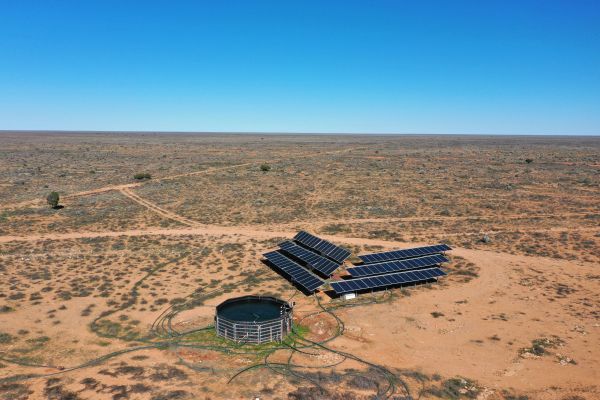
CC Cooper & Co purchased the property in 2016 and has painstakingly developed the property further through a significant capital works program aimed at maximising the efficiency and productivity of the asset. Central to this has been a water infrastructure revitalization program which has seen 1,400km of interconnected pipelines installed, delivering reliable good quality water across the vast property, unlocking it’s full producion potential. The water delivery system is best in class, including solar powered pumping systems at all critical points in the water system, and remote monitoring via smartphone and Starlink-enabled connectivity, enabling management and monitoring of pumps and tanks from anywhere.
There has been over 1,000km of fencing installed, subdividing very large paddocks to create 118 paddocks and 376km of internal laneways. This optimizes grazing management and rotation, as well as reducing grazing pressure around water points.
Significant investments have also been made in animal handling infrastructure. A 10,000 head sheep feedlot and holding yards have been established in a central location and there are modern yards located strategically throughout. Technology has been extensively adopted. Every ewe is tagged with electronic identification (eID), enabling detailed individual records and auto drafter functionality that can draft animals by paddock, performance, age, sex or shearing. Starlink internet is supported at key infrastructure points across more than 118 paddocks, including bore sites to provide remote monitoring, coordination and communication.
A significant flock of c60,000 sheep is included (Canowie Poll Merino gene cs) together with 3,500 Boer X goats, plus kids.
CPC has an equally long history in Australian agriculture, dating back to 1879. In October 2020, the UK based Hands Family purchased 100% of CPC. Since then, CPC has continued to grow its portfolio, overseen by itsAustralian and Indonesian management team headed by CEO and Director Troy Seter.
CPC owns and operates a portfolio of eleven station aggregations in Australia and two feedlots in Indonesia. Across more than 5.5m hectares of land, the CPC team can care for more than 400,000 head of catle,45,000 goats and produce a diverse range of crops. With an asset base in excess of AUD$1.6 billion, CPC supplies a variety of domes c and international customers.
CPC owns the iconic Isis Downs Sta on that was one of Australia’s largest sheep stations running nearly 300,000 sheep and today runs 31,000 cattle and 45,000 goats.
Tom Russo, Chief Executive Office of Elders, said:
“The sale process again demonstrated the confidence of the Australian sheep and wool production industry. Ultimately, it’s exciting to see CPC invest again after their recent acquisition of Rawlinna. Whilst not quite contiguous, the two stations are in close proximity and will complement each other. We believe that the integrated operation is the largest sheep station in the world.”
Mr David Seth Cooper (Seth), CC Cooper and Co, said:
“We acquired Madura Plains with the clear strategic intent to build a best in class modern sheep station that fully capitalises on the production potential of the vast landholding and stock water supply, whilst being resilient through the cycles. We have also invested to deliver operational efficiencies and maximise animal welfare and sustainability outcomes. We are proud that we have achieved our vision and it’s now the right time for us to deliver the finished product to a new custodian”.
“We are delighted with the outcome of the sale process and excited to see what the future holds for Madura Plains after a period of significant development and investment by our family. We are particularly pleased that the Madura Plains team will be retained and no doubt given great opportunities within CPC, given the scale and diversity of their operations nationally.”
Mr Troy Seter, CEO and Director of CPC said:
“The opportunity to combine Rawlinna and Madura Plains was very compelling and will allow us to achieve significant operational efficiencies that are required today in rangelands sheep production. The Rawlinna acquisition allowed CPC to reenter the Australian sheep production space at scale and the integration of Madura Plains will accelerate our ambition of building out the sheep platform of our diversified portfolio, which includes cattle, goat, sheep and wool production, natural capital and over 20,000 hectares of cropping capacity.”